
Source-available video CLI driven by a coding agent; framework is $0, hosted generation credits from $9.90/month
Researched by Gan Liu · Founder & lead researcher
for the self-hosted source-available CLI (bring your own model keys); hosted credits from $9.90/month (Starter — $9.90/month on either billing interval)
Opens hypit.ai in a new tab
Hypit starts at $0. Best for teams already working inside Claude Code or Codex who want video production in that same session instead of a separate web tool.
Best for teams already working inside Claude Code or Codex who want video production in that same session instead of a separate web tool
Skip it if brands that need a real person holding the product on camera — Hypit generates everything; a creator marketplace such as Billo, Influee or Insense is the right shape
Full editorial review in progress — the facts above are verified from Hypit’s own pages and third-party ratings.
What is Hypit?
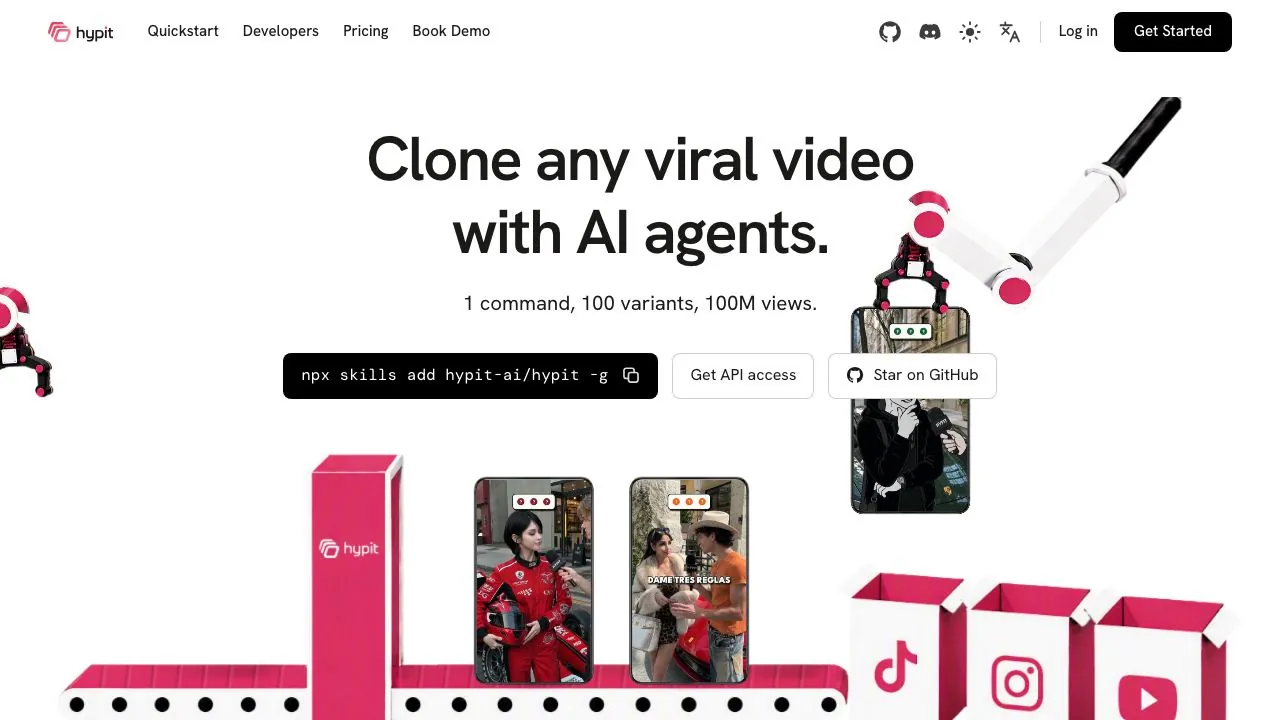
Hypit is a source-available video toolchain that installs into a coding agent (Claude Code, Codex and similar) with `npx skills add hypit-ai/hypit -g`. The agent takes a reference video or a written brief and rebuilds it as an editable project — script, word-aligned captions, B-roll, motion graphics and effects — then re-runs that project to produce batches of variants with the presenter, product, language or aspect ratio swapped. Hypit's README states the framework carries no seat pricing, per-render fees or added watermark; generation is paid for either through Hypit's own hosted gateway (HypiHub, sold in credits from $9.90/month) or through your own third-party model keys. That README lists paid social ads, viral clones, TikTok Shop and affiliate videos and 'AI UGC and talking heads' under 'What Hypit Can Build', and states total generation costs of $1.15, $1.07 and $1.09 for its three worked demo videos — the vendor's own figures for its own runs, not independently verified. The homepage carries a comparison table naming Arcads, Higgsfield and Seedance. Terms of Use identify the operator as Shenzhen Kaxi Yongliu Technology Co., Ltd.
What can Hypit do?
Installs into a coding agent, not a web app
A single command, `npx skills add hypit-ai/hypit -g`, registers a Hypit skill for Claude Code, Codex or another agent that can use skills. The Skill supplies production knowledge and the hypit package supplies the executable; the quickstart says you do not need to clone the repository.
Reference-video cloning
The agent takes a video file or a supported platform link and rebuilds the whole workflow — shots, pacing, captions, B-roll and effects — rather than just extracting a script. Presenter, product, language, aspect ratio and call to action can each be swapped.
Word-anchored timing
WhisperX word alignment supplies the words and their timing, so per Hypit's docs captions, graphics and cuts are anchored to spoken words instead of seconds and a rewritten line re-flows its own timing.
Batch variant runs
Hypit's homepage comparison table claims a batch scale of '10, 50, or 100+ per run' by reusing one composition and regenerating only the parts that change. The hero line is '1 command, 100 variants, 100M views.' — the vendor's own claim, not measured here.
HypiHub credit gateway
The API overview states one key and one balance fan out across 'roughly two dozen upstream image, video, audio and chat vendors' (Seedance 2.0/2.5, GPT Image 2, MiniMax H3, Grok Imagine and others). /v1/chat/completions and /v1/models are described as drop-in compatible with the official OpenAI SDKs.
Bring-your-own-key and self-hosting
The distribution bundles API-key providers for TokenDance, HiAPI, Pollo and Monid, and you can point Hypit at your own model deployment. Hypit's docs state a partnership is 'an introduction, not a shared HypiHub account' — those services bill you directly.
Modified Apache-2.0 source licence
The repo LICENSE is 'a modified version of the Apache License 2.0, with the following additional conditions': internal and client work is allowed, but operating a multi-tenant environment, offering Hypit to third parties as a hosted or managed service, or supplying it for commercial gain requires a written commercial licence, and Hypit's name, logo and copyright may not be removed from the CLI or its run reports.
Editable project output and Studio
A run produces a re-runnable composition — SVML source, SVS recipe stylesheets and build results — rather than a one-off MP4, and Hypit Studio opens the composition so its timing and appearance can be explored and edited.
Metered, reserve-and-settle billing
Async jobs reserve credits from a deliberately conservative estimate, settle to the real figure on success, and refund everything taken on failure or queue expiry; a call the balance cannot cover is refused with a 402 rather than run unmetered.
Generation models are optional
The README states a workflow can compile captions, motion graphics and code-rendered visuals into a finished video 'without calling a generation model or incurring its service charges', so some outputs cost nothing beyond your own compute.
Use cases
- Teams already working inside Claude Code or Codex who want video production in that same session instead of a separate web tool
- Performance marketers re-running one proven format across many hooks, products, SKUs or languages
- Buyers who want to keep model choice and generation spend on their own API keys rather than a vendor's bundled catalogue
- Engineering-led studios that need to fork, modify or self-host the pipeline for a single organisation
- Anyone who wants an editable, re-runnable project file they can revise later rather than a finished MP4
Look elsewhere if
- Brands that need a real person holding the product on camera — Hypit generates everything; a creator marketplace such as Billo, Influee or Insense is the right shape
- Non-technical marketers: the entry point is a terminal command and an agent session, with no web brief form or editor
- Buyers who must budget against a fixed per-video price — credits do not convert to a published cost per finished video
- Anyone wanting to resell Hypit or run it as a multi-tenant SaaS without first buying a written commercial licence from the vendor
- Procurement processes that require third-party reviews, named references or a track record longer than a couple of months
Hypit pros and cons
Pros
- The framework itself is free and source-available — the LICENSE and README state no seat pricing, no per-render fee and no added watermark, and the LICENSE explicitly permits running it yourself for your own organisation's commercial work and for client work
- Every hosted price is published on one page: three plans, four top-up packs and a per-second model rate card, with only the Business tier behind an email contact
- Per-model credit rates are published (Seedance 2.0 at 20.9 credits/second, Mini at 4.2) and the API exposes pricing.credits on each model card, so an agent can price a run before spending
- Model choice is not locked in — bundled BYOK providers ship for TokenDance, HiAPI, Pollo and Monid, and you can point it at your own deployment instead of buying Hypit credits at all
- Output ownership is stated in writing: LICENSE section 3 says the producer claims no rights in the videos, audio, images or manifests you create, including commercial use
- Failed or queue-expired jobs are refunded in full per the API billing doc, and a call that would overdraw the balance is refused with a 402 rather than served unmetered
- Top-up credit packs never expire and are spent only after the expiring subscription grant, which is the buyer-favourable ordering
- Not every video needs a paid generation call — the README states a workflow can compile captions, motion graphics and code-rendered visuals into a finished video without calling a generation model
- Actively shipped — the GitHub API showed release v0.2.10 published 2026-09-20 and 11,212 stars on the repository, both read on the day this record was written
Cons
- No per-video price can be derived. Plans are sold in generic media credits and the pricing page never states how long a 'Seedance 2.0 video' is, so the '7 / 42 / 114 videos' estimates cannot be turned into a cost per finished UGC ad
- The pricing page opens on the Annual tab, so the headline $39.90 (Pro) and $99.90 (Ultra) are annual-billed monthly equivalents; the struck-through $49.90 and $129.90 are the actual month-to-month prices, confirmed in Hypit's own Schema.org offers
- Annual billing saves nothing at the entry tier — Starter is $9.90/month either way ($118.80/year), despite the 'Save up to 23%' badge sitting above it
- Top-up credits are dearer per credit than plan credits ($0.0065-$0.0075 versus $0.0037-$0.0055), so overrunning a plan is punished rather than smoothed
- Subscription credits expire with each billing period and are spent before pack credits — an unused month is lost
- Even the published USD rate card cannot be safely extrapolated: Hypit's own billing doc says the per-model multiplier is hidden and 'any arithmetic done on the dollar figures will be wrong exactly on the models where being wrong costs money'
- Requires a coding agent and a terminal. There is no web editor or brief form, so a brand marketer without Claude Code or Codex cannot use the product at all
- No human creators and no rights clearance — everything on screen is generated or supplied by you, and the Terms put the burden of likeness, voice and reference-video permissions entirely on the buyer
- No independent review score could be verified: G2, Trustpilot, Capterra and Product Hunt all returned HTTP 403 to this check. Meanwhile the homepage runs Google, Microsoft, Meta, NVIDIA, OpenAI, Anthropic, Adobe, Alibaba, ByteDance, Tencent, Baidu, DiDi, Peking University and Tsinghua logos under 'Trusted by teams from' without naming a single customer or linking a case study
- Very young and versioned inconsistently — the GitHub repo was created 2026-07-29 and the Terms took effect 2026-09-07, while the on-site changelog holds only two entries with 'v1.0.0, August 28 2026' as the newest, and GitHub is shipping v0.2.x
- Contracting is with a Shenzhen-registered company under PRC law, with disputes heard in the courts where Hypit is domiciled in Shenzhen and total liability capped at the greater of 12 months of fees or USD $100
- Running Hypit as a hosted or multi-tenant service for anyone outside your own organisation, or bundling it into a product you sell, needs a separate written commercial licence — it is not plain Apache-2.0
Sources consulted
as of 2026-09-20- hypit.ai (opens in a new tab)
- hypit.ai (opens in a new tab)
- hypit.ai (opens in a new tab)
- hypit.ai (opens in a new tab)
- hypit.ai (opens in a new tab)
- hypit.ai (opens in a new tab)
- hypit.ai (opens in a new tab)
- hypit.ai (opens in a new tab)
- hypit.ai (opens in a new tab)
- hypit.ai (opens in a new tab)
- raw.githubusercontent.com (opens in a new tab)
- raw.githubusercontent.com (opens in a new tab)
- api.github.com (opens in a new tab)
- api.github.com (opens in a new tab)
Quick facts about Hypit
- Pricing
- Self-hosted core (bring your own keys)$0softwareStarter$9.90/month billed monthly, or $118.80/year (= $9.90/month, no annual saving)/moPro$49.90/month billed monthly, or $478.80/year (= $39.90/month, badged '20% OFF')/moUltra$129.90/month billed monthly, or $1,198.80/year (= $99.90/month, badged '23% OFF')/moPay-as-you-go credit packs2,000 credits $15.00; 5,000 credits $35.00; 10,000 credits $65.00; 20,000 credits $130.00one-offBusiness (Custom Plan)Custom — contact salescustom
BILLING-TOGGLE TRAP — the pricing page loads with the Annual tab pre-selected (aria-selected="true" on 'Annual', aria-selected="false" on 'Monthly'), and every plan's checkout link carries interval=year. As rendered, Pro shows a struck-through $49.90 with $39.90/month as the headline, and Ultra shows a struck-through $129.90 with $99.90/month. Those struck-through numbers are NOT old list prices: Hypit's own Schema.org offers on the same page publish two offers per plan — PRO interval=month $49.90 and interval=year $478.80; ULTRA interval=month $129.90 and interval=year $1,198.80; STARTER interval=month $9.90 and interval=year $118.80. So $49.90 and $129.90 are the real month-to-month prices, and $39.90/$99.90 are annual-billed monthly equivalents. An earlier verification pass on this platform read these as 'list price struck through, currently charged $39.90'; that reading is wrong and is corrected here. Starter is $9.90 either way ($9.90 x 12 = $118.80) and carries no discount badge, so the 'Save up to 23%' badge above the toggle buys nothing at the entry tier. NO PER-VIDEO PRICE — plans are sold in generic media credits spanning images, video, audio and tokens. The only video anchors published are the 'Estimated output' counts (7 / 42 / 114 'Seedance 2.0 videos' per plan) and a per-second rate card (Seedance 2.0 20.9 credits/second, Seedance 2.0 Fast 27.3, Seedance 2.0 Mini 4.2, Seedance 2.5 125.4, MiniMax H3 from 17.6, Grok Imagine 2.6; the Seedance 2.0 720p, 1080p and 4K rows are all shown as '—'). No video length is stated anywhere, so a cost per finished UGC video cannot be read off the page. The rate card's dollar columns resolve to the annual credit value (Pro $39.90 / 10,000 credits x 20.9 = $0.083, matching the $0.08 shown; Ultra's Grok Imagine cell of $0.0096 matches 2.6 x $99.90/27,000 and not the month-to-month figure). The page says only 'Plan columns show the per-unit USD price at each plan's credit value' and never states which billing interval it assumes, and only one set of figures is served in the HTML. VENDOR WARNS AGAINST ITS OWN ARITHMETIC — the API billing doc tells clients to read pricing.credits from the model card rather than compute it, because 'the per-model multiplier is deliberately not exposed, so any arithmetic done on the dollar figures will be wrong exactly on the models where being wrong costs money' — while the pricing page itself publishes exactly such derived dollar columns. TOP-UPS COST MORE THAN PLAN CREDITS — $15.00/2,000 = $0.0075 per credit and $130.00/20,000 = $0.0065, against $0.0055 (Starter), $0.0040 (Pro annual, $0.0050 month-to-month) and $0.0037 (Ultra annual, $0.0048 month-to-month). CREDIT EXPIRY — the pricing page says plan credits are 'refreshed every month' and 'reset each period and are spent first', and the API billing doc confirms a subscription grant expires with its billing period while packs do not. SELF-CONTRADICTION ON SOFTWARE COST — the homepage comparison table lists Hypit's software cost as '$0 open-source core' next to Arcads at 'Reported ~$110+/mo' and Higgsfield at '$19-$129/mo', while Hypit's own pricing page sells $9.90-$129.90/month plans. Both are true of different things (framework vs hosted generation credits), but the homepage never says so, and the Arcads/Higgsfield figures are Hypit's characterisation of competitors, not verified here. CURRENCY — the Chinese pricing page (/zh/commercial/pricing/) carries the identical USD figures, no local-currency variant. NO FREE TIER OR TRIAL — the pricing page lists no free plan and no trial. The only free thing on offer is an asset giveaway: the README and quickstart link a Google Drive folder headed 'Get 100 FREE AI Avatars with unique voices' — files, not credits. Terms 11.5 state payments are non-refundable except where law or a published refund policy requires otherwise, though the API billing doc says failed or queue-expired jobs are refunded in full. Business/Custom Plan is the only price not published. Checked for an affiliate programme at /affiliate, /affiliates and /partners (all 404) and in the site footer — none found.
- Ratings
No third-party ratings found on Trustpilot, G2 or Capterra.
- Min. spend
- $0 to run the source-available CLI with your own model keys; the smallest hosted purchase published is a $15.00 / 2,000-credit top-up pack or the $9.90/month Starter plan
- Usage rights
- The repo LICENSE, section 3 'Ownership of output', states that the producer claims no rights in the content you create with Hypit — 'Videos, audio, images, manifests, and any other artifacts produced through your use of Hypit belong to you, and this license imposes no conditions on their use — including commercial use' — while noting that content generated by way of third-party model or service providers may additionally be subject to those providers' terms. Terms of Use 8.1 repeats that Hypit does not restrict you from using Outputs for lawful purposes including commercial ones and will not claim ownership of your original contributions; 8.2 warns that Outputs may not be unique and that Hypit does not guarantee you can obtain copyright, trademark or other proprietary rights in them. Separately, LICENSE 1(c) forbids removing or modifying Hypit's name, logo or copyright information in the CLI, its generated run reports and manifests, or any user-facing surface derived from them.
Frequently asked questions
The self-hosted CLI is $0 — Hypit's README states there is no seat pricing, per-render fee or added watermark. Hosted generation credits are sold separately: Starter $9.90/month (or $118.80/year, the same rate), Pro $49.90/month month-to-month or $478.80/year (= $39.90/month), and Ultra $129.90/month month-to-month or $1,198.80/year (= $99.90/month). One-off credit packs run $15.00 for 2,000 credits up to $130.00 for 20,000. A Business plan is quoted on request. All figures read on hypit.ai/commercial/pricing/ on 2026-09-20.
Because the billing toggle loads on Annual. The struck-through $49.90 and $129.90 are the genuine month-to-month prices; $39.90 and $99.90 are what the same plans cost per month when you pay $478.80 or $1,198.80 up front for a year. Hypit's own Schema.org offer data on that page publishes both intervals explicitly, and every checkout link on the page carries interval=year. Starter is $9.90 either way, so the annual toggle saves nothing at the entry tier.
It is source-available rather than strictly open source. The repo LICENSE is 'a modified version of the Apache License 2.0, with the following additional conditions': you may run it yourself, use it for your own organisation's commercial work and for client work, and fork and republish it under the same licence — but operating a multi-tenant environment, offering Hypit's functionality to third parties as a hosted or managed service, or supplying it for commercial gain requires a written commercial licence. GitHub classifies the licence as 'Other / NOASSERTION'.
You do. LICENSE section 3 says the producer claims no rights in videos, audio, images or manifests produced through your use of Hypit and imposes no conditions on their use, including commercial use. Terms of Use 8.1 says the same. Two caveats the vendor states itself: content made by way of third-party model providers may also be subject to those providers' terms, and 8.2 warns Outputs may not be unique or protectable.
Not from the published pricing. Credits are generic across images, video, audio and tokens, and the pricing page gives only an 'Estimated output' of 7, 42 or 114 'Seedance 2.0 videos' per plan without saying how long one is. The rate card does publish per-second credit rates (Seedance 2.0 at 20.9 credits/second, Mini at 4.2), so you can price a known clip length — though Hypit's own billing doc warns that arithmetic on its dollar figures will be wrong on some models because a per-model multiplier is not exposed. The README quotes total costs of $1.15, $1.07 and $1.09 for its three worked demo videos; that is the vendor's own figure for its own runs, not a rate card.
No. Everything on screen is either generated by an upstream model (Seedance, GPT Image 2, MiniMax H3 and others) or supplied by you. There is no creator marketplace, no casting and no creator-side rights clearance — Hypit's Terms put the burden of securing likeness, voice and reference-video permissions on the buyer.
Effectively yes. The documented entry point is installing a skill into a coding agent such as Claude Code or Codex with `npx skills add hypit-ai/hypit -g` and then directing that agent from a terminal. There is no web briefing form or self-serve editor for buyers; Hypit Studio opens an existing composition for timing and appearance edits, not as a starting point.
The pricing page lists no free plan and no trial. The framework itself is free to install and run if you bring your own model API keys, but Hypit's quickstart states that installing the Skill or executable does not include generation credits. The only free offer found is an asset giveaway — the README and quickstart link a Google Drive folder headed 'Get 100 FREE AI Avatars with unique voices', which is files rather than credits. Terms 11.5 say payments are non-refundable except where law or a published refund policy applies, though the API billing documentation says failed or queue-expired jobs are refunded in full.
Subscription credits do not — the pricing page says plan credits are 'refreshed every month' and 'reset each period and are spent first', and the billing documentation confirms a subscription grant expires with its billing period. One-off top-up packs never expire, and spending always draws down the expiring subscription grant first.
Alternatives to Hypit
Looking for a Hypit alternative? Compare these UGC platforms with similar use cases and verified pricing.
| Platform | Starting price | Model | Rating | Turnaround | |
|---|---|---|---|---|---|
| $0 | Credit-based | — | — | Visit | |
| $110 /mo | Subscription | 2.7 out of 5 / 5 | Minutes per generated video (AI generation, no creator shipping/filming) | Visit | |
| $39 /mo | Credit-based | 4.8 out of 5 / 5 | Minutes per video (AI-generated; batch of up to 50 variations at once) | Visit | |
| $16 /mo | Credit-based | 3.5 out of 5 / 5 | Minutes for credit-based renders; 'unlimited' queue renders reported at 6-68 hours | Visit | |
| $49 /mo | Subscription | 3.0 out of 5 / 5 | Minutes per video — template-based rendering is near-instant; automations post on your schedule | Visit |