
OpenShorts
openshorts.app(opens in a new tab)Open-source AI clip generator with an AI-actor UGC mode; free self-hosted under MIT, or hosted from $12/month
Researched by Gan Liu · Founder & lead researcher
self-hosted (MIT, Docker, bring your own API keys); OpenShorts Cloud paid plans start at $12/month for 100 minutes with no watermark
Opens openshorts.app in a new tab
OpenShorts starts at $0. Best for teams already repurposing long-form video who want AI-actor UGC as a second output from the same tool.
Best for teams already repurposing long-form video who want AI-actor UGC as a second output from the same tool
Skip it if brands that need real humans on camera — every actor here is AI-generated or a photo you supply
Full editorial review in progress — the facts above are verified from OpenShorts’s own pages and third-party ratings.
What is OpenShorts?
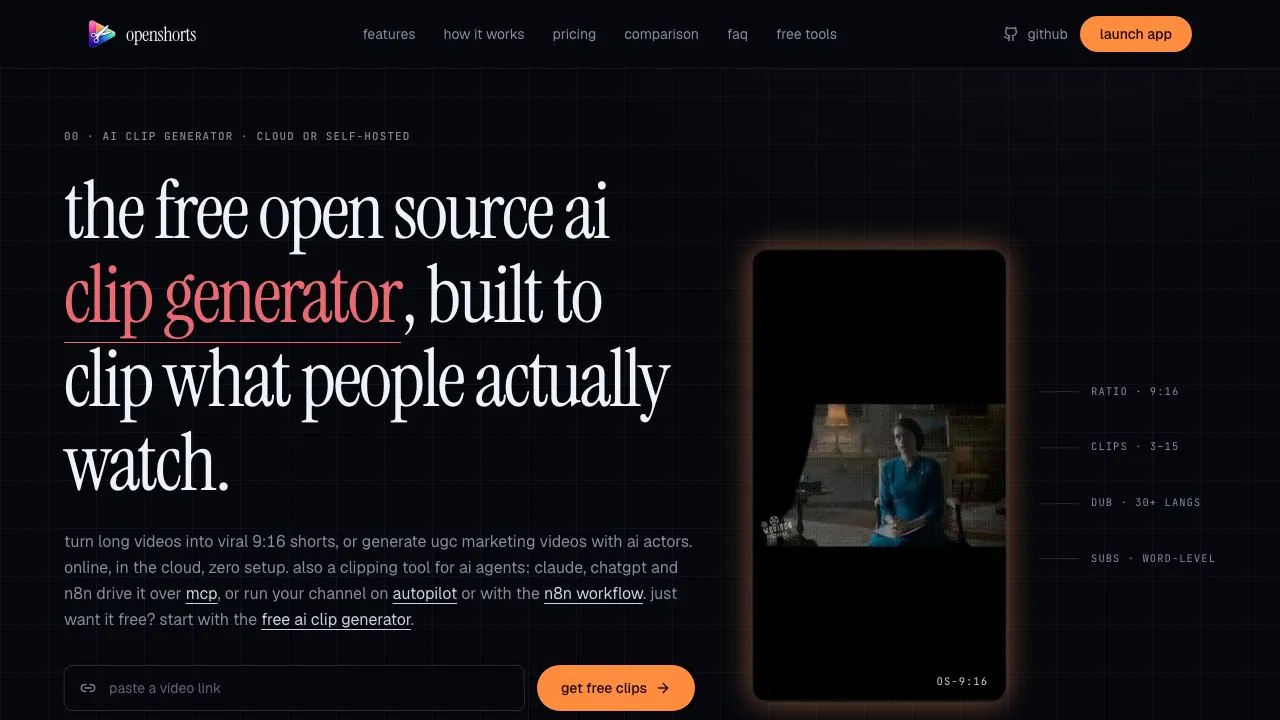
OpenShorts is an open-source video platform that ships three tools in one codebase: a long-video-to-9:16 clip generator, an 'AI Shorts' UGC generator that writes a script and renders a lip-synced AI actor with voiceover, b-roll and a hook overlay, and a YouTube studio for thumbnails, titles and descriptions. It exists in two editions that are priced very differently: the self-hosted edition runs with Docker under the MIT licence at $0 with no watermark and no usage cap, and OpenShorts Cloud is the same software on the vendor's GPUs, billed in processing minutes. The hosted service is operated by TONVI TECH SL, CIF B-19780394, of Malaga, Spain, per the Legal Notice and section 1 of the Terms. UGC is the second of the three tools — the vendor's own comparison table on the homepage benchmarks OpenShorts against clip repurposers (Submagic, Opus Clip, Vizard, Klap), not against AI UGC ad platforms. The public GitHub repository showed 5,283 stars, 1,231 forks and a last push of 2026-09-17 when read via the GitHub API on 2026-09-20; star counts move daily.
What can OpenShorts do?
AI Shorts — AI-actor UGC generator
Describe a business or paste a URL; the AI writes a script, generates a lip-synced actor with voiceover, and adds b-roll, subtitles and a hook overlay. Actors come from Flux 2 Pro generation, a shared gallery, or a photo you upload.
Two cost modes for UGC output
Low Cost uses Hailuo 2.3 Fast img2video plus VEED Lipsync; Premium uses Kling Avatar v2. The vendor puts these at about $0.65 and about $2.00 per video respectively, as fal.ai charges billed by that vendor rather than by OpenShorts.
Long-video-to-shorts clip generator
The primary tool: faster-whisper transcribes with word-level timestamps, PySceneDetect finds scene boundaries, and Google Gemini 3.1 Flash-Lite scores the transcript to pick 3 to 15 moments of 15 to 60 seconds, cut with FFmpeg and reframed to 9:16 with MediaPipe face tracking.
Self-hostable under MIT
The whole pipeline runs with Docker Compose on your own hardware, so source video never leaves your infrastructure. The cloud/ directory covering billing and managed keys is excluded from the MIT grant under a separate commercial licence; GitHub's API reports the repository licence as 'Other / NOASSERTION' for that reason.
MCP server, REST API and CLI
A native MCP endpoint at mcp.openshorts.app/mcp exposes eight tools (process_video, create_upload, get_job_status, list_clips, get_quota, add_subtitles, recut_clip, publish_clip), plus a REST API with per-user keys, completion webhooks and a pip-installable CLI.
Direct publishing to social accounts
Clips and UGC videos can be posted to TikTok, Instagram Reels and YouTube Shorts from the dashboard via the vendor's publishing partner Upload-Post (Terms section 10); you remain the publisher of everything posted.
Dubbing into 30+ languages
ElevenLabs translates the audio while preserving the speaker's voice characteristics, then the track is re-transcribed so burned-in subtitles match the target language.
Machine-readable AI-content marking
Per Terms section 7, AI-dubbed clips, AI-actor videos and generated thumbnails are tagged as AI-generated in machine-readable form (a metadata tag on video; XMP DigitalSourceType: trainedAlgorithmicMedia on images) to satisfy EU AI Act Article 50(2). No visible label is burned into the picture, and the vendor warns that platform re-encodes can drop the marking.
Use cases
- Teams already repurposing long-form video who want AI-actor UGC as a second output from the same tool
- Developers and agencies who need source video to stay on their own infrastructure and are willing to run Docker
- Agent-driven pipelines — the native MCP server, REST API and CLI are first-class, not bolted on
- Buyers testing whether AI-actor UGC works for them at the lowest cost floor available before committing to a per-seat platform
- Budget-constrained local businesses and solo marketers who can live with a 20-minute monthly free tier and a watermark
Look elsewhere if
- Brands that need real humans on camera — every actor here is AI-generated or a photo you supply
- Buyers who require the full price ladder in public before signing up; only $12 and 'up to $59' are published
- Teams with no appetite for Docker, GPU drivers and four separate third-party API keys if they want the $0 edition
- Campaigns needing creator whitelisting, Spark Ads, or usage rights tied to a named human creator's likeness
- Buyers who need a firm per-UGC-video cost on the hosted plan — as of 2026-09-20 we did not find that figure on the pages listed under sources
- Teams that expect the platform to be their asset library — clips are deleted 7 days after the free plan generates them or after a paid subscription ends
OpenShorts pros and cons
Pros
- Self-hosted edition is $0 with no watermark and no usage cap under MIT, and the pipeline source is public and auditable
- Hosted entry price is $12/month for 100 minutes without a watermark — low for this category, and the figure is repeated identically across seven of the vendor's own pages plus the README
- Terms section 4 assigns clip ownership to the customer including commercial use, and section 7 states the vendor does not train AI models on customer content
- API and MCP calls draw from the same minute balance as the dashboard rather than a separate per-call meter (vendor's claim on /mcp)
- One of very few vendors in this category that publishes any per-video AI UGC cost figure at all, even though it is a third-party API cost rather than its own
- Repository is actively maintained — 5,283 stars, 1,231 forks and a last push of 2026-09-17, read from the GitHub API on 2026-09-20
- Unusually specific consumer terms: a plain-language refund policy, an explicit EU 14-day withdrawal right, and 30 days' notice before any price increase
Cons
- There is no pricing page — /pricing 404s — and only the two endpoints of the paid ladder are published ($12 and 'up to $59'), so you cannot see what you would actually buy without creating an account
- The Legal Notice read today points at a 'pricing page' that does not exist; whether the $12 is tax-inclusive is only resolvable at Stripe checkout
- The Terms and Refund Policy both sell 'minute top-ups', but no top-up price or minute bundle is published anywhere
- UGC is the second of three tools; the product's centre of gravity is long-video repurposing, and the vendor benchmarks itself against Opus Clip, Submagic, Vizard and Klap rather than against AI UGC ad platforms
- The $0.65 / $2.00 per-video figures are fal.ai charges for self-hosters with their own key — the vendor says so itself on /free-ai-clip-generator — and nothing published states how AI Shorts is metered or charged on OpenShorts Cloud
- The vendor contradicts itself on that cost: the README's own table prices the same fal.ai calls at '~$0.50-1.50 per AI Short' against '~$0.65' and '~$2' elsewhere on the same README and the homepage
- Hosted billing is denominated in processing minutes, a unit designed for clip repurposing, which maps awkwardly onto 'how many UGC ads can I ship this month'
- No human creators anywhere in the product — actors are Flux-generated or uploaded photos, so there is no creator marketplace, no real-person testimonial, and no creator whitelisting or Spark Ads path
- Free-tier exports are watermarked and the Terms forbid removing or obscuring the watermark by any means other than upgrading
- Storage is short-lived on both tiers: Terms section 13 deletes free-plan clips after 7 days and paid-plan clips 7 days after the subscription ends, so the archive is yours to keep only if you download it
- The $0 path is real but operationally expensive: Docker, 8GB+ RAM, an NVIDIA GPU to be fast, and your own Gemini, fal.ai, ElevenLabs and Upload-Post keys and bills — the README's own figures put Upload-Post's free tier at 10 uploads a month
- No third-party rating could be verified: G2, Trustpilot and Capterra all returned 403 to automated requests on 2026-09-20 (a block, not proof that no reviews exist) and producthunt.com/products/openshorts returned 404
Sources consulted
as of 2026-09-20- openshorts.app (opens in a new tab)
- openshorts.app (opens in a new tab)
- openshorts.app (opens in a new tab)
- openshorts.app (opens in a new tab)
- openshorts.app (opens in a new tab)
- openshorts.app (opens in a new tab)
- openshorts.app (opens in a new tab)
- openshorts.app (opens in a new tab)
- openshorts.app (opens in a new tab)
- openshorts.app (opens in a new tab)
- openshorts.app (opens in a new tab)
- api.github.com (opens in a new tab)
- raw.githubusercontent.com (opens in a new tab)
- raw.githubusercontent.com (opens in a new tab)
Quick facts about OpenShorts
- Pricing
- Self-hosted (MIT)$0foreverOpenShorts Cloud — Free$0/moOpenShorts Cloud — entry paid plan$12/moOpenShorts Cloud — stated ceilingup to $59/moMinute top-upsNot publishedone-offAI Shorts (AI UGC video) — third-party API costabout $0.65 (Low Cost) / about $2.00 (Premium)per video
There is no pricing page. https://www.openshorts.app/pricing returned 404 on 2026-09-20 and no pricing URL appears in the site's own sitemap.xml; every price above was read off the homepage, which is why pricingUrl points there. Against that, the headline price string is unusually well corroborated: the identical sentence 'Paid plans start at $12/month for 100 minutes with no watermark, up to $59/month' appears on seven openshorts.app pages (homepage, /alternatives, /mcp, /how-openshorts-works, /free-ai-clip-generator, /free-ai-clip-generator-no-watermark, /open-source-ai-video-generator) and in the GitHub README. No annual-billing option or annual discount is advertised anywhere — every figure on the site is a monthly price, so there is no monthly-versus-annual headline trap here. The paid ladder is published at its two endpoints only: '$12/month for 100 minutes' and 'up to $59/month'. No tier name, minute allowance or feature list exists publicly for anything in between. Separately, the Terms (sections 2 and 11) and the Refund Policy all sell 'minute top-ups' through Stripe, and no top-up price is published either. The Legal Notice contradicts the site's own structure: read today it says 'Prices shown on the pricing page indicate whether taxes are included; where they are not, the applicable tax is displayed at checkout before you pay' — referring to a pricing page that does not exist. The tax question is still answered elsewhere (Terms section 11: 'Prices are shown with any applicable taxes indicated at checkout'), so the practical effect is that whether the $12 is tax-inclusive is only resolvable at Stripe checkout. hasFreeTrial is recorded as true, but the 20 minutes/month free tier is a recurring allowance rather than a time-limited trial, and it watermarks exports. On the AI UGC figures the vendor contradicts itself: the homepage feature card ('from $0.65 per video'), the homepage FAQ ('about $0.65' / 'about $2.00') and the README's AI Shorts section ('~$0.65/video' and '~$2/video') agree, but the README's own 'How Much Does It Cost?' table prices the identical fal.ai calls at '~$0.50-1.50 per AI Short'. All of these describe money you pay fal.ai directly when self-hosting with your own key — /free-ai-clip-generator says plainly that fal.ai for AI UGC video is 'billed by those vendors' — and no page states how AI Shorts consumes quota or costs money on OpenShorts Cloud, so a hosted buyer cannot compute a per-UGC-video price from published information. Storage is time-limited on both tiers (Terms section 13): free-plan clips are deleted after 7 days, paid-plan clips 7 days after the subscription ends. Refund policy (read today): most recent charge only, within 14 days, and only if no minutes were spent since; EU consumers additionally keep a 14-day withdrawal right under Terms section 12 with pro-rata payment for what they used.
- Ratings
No third-party ratings found on Trustpilot, G2 or Capterra.
- Turnaround
- Clip generation: about 50 seconds for an 8-minute video on OpenShorts Cloud's NVIDIA GPU, versus 5 to 8 minutes on a typical CPU when self-hosted (vendor's homepage figures). No turnaround figure is published for AI Shorts UGC videos.
- Min. spend
- None. Self-hosted is $0 and the hosted free tier (20 min/month) needs no credit card; the smallest paid commitment is $12/month, cancellable at any time from the account page.
- Usage rights
- Terms of Service section 4, read 2026-09-20: 'As between you and us, you own the output clips the service generates from your content, including for commercial use, to the extent of our rights in them.' You keep ownership of the videos you submit and grant the vendor only the licence needed to host and process them; section 7 states the vendor does not use customer content to train AI models. Free-plan clips carry an OpenShorts watermark that you may not remove or obscure except by upgrading. You must hold the rights to every source video you upload or link, and under section 10 you remain the publisher of anything posted through the service. AI-generated output is tagged as AI-generated in machine-readable form under EU AI Act Article 50(2) and you must not strip that marking; disclosing AI generation to your audience is your own duty as deployer under Article 50(4).
Frequently asked questions
Two editions, priced differently. Self-hosted is $0 under the MIT licence with no watermark and no cap, but you run it on Docker and pay Google Gemini, fal.ai, ElevenLabs and Upload-Post directly. OpenShorts Cloud has a free tier of 20 minutes a month with a watermark and no credit card, and paid plans the homepage describes as starting at $12/month for 100 minutes without a watermark, 'up to $59/month'. Read on the homepage on 2026-09-20; there is no pricing page.
The homepage says 'from $0.65 per video' and its FAQ says Low Cost mode is about $0.65 and Premium about $2.00. Those are fal.ai charges you pay when self-hosting with your own key — the vendor's /free-ai-clip-generator page says fal.ai for AI UGC video is 'billed by those vendors' — and the project's own README gives a conflicting range of about $0.50 to $1.50 for the same calls. No page states how AI Shorts is metered on OpenShorts Cloud, so hosted buyers cannot derive a per-video price from published information.
No. Every presenter is AI: an actor image generated with Flux 2 Pro, one picked from a shared gallery, or a photo you upload, animated into a lip-synced talking head. There is no creator marketplace, no creator payouts and no human-creator licensing path.
You do, with a qualifier the Terms spell out. Section 4 states that as between you and the vendor, you own the output clips including for commercial use, 'to the extent of our rights in them', and section 7 says customer content is not used to train AI models. Free-plan exports carry a watermark you may not remove except by upgrading, and AI-generated output carries a machine-readable AI marking you must not strip.
The self-hosted edition is, under MIT — the homepage describes it as having no watermark, no usage cap and no subscription. What it costs is hardware and setup: Docker, 8GB+ RAM, an NVIDIA GPU if you want speed, and your own API keys. The hosted free tier is 20 minutes a month, watermarks exports, and deletes clips after 7 days. The cloud/ directory that handles billing and managed keys is excluded from the MIT grant under a separate commercial licence, so you cannot resell the hosted service.
Primarily a clip repurposer with a UGC mode attached. The README describes '3 tools in one: Clip Generator, AI Shorts (UGC videos with AI actors), and YouTube Studio', and the homepage comparison table benchmarks OpenShorts against Submagic, Opus Clip, Vizard and Klap — clip tools — rather than against AI UGC ad platforms. Buy it for UGC only if you also want the repurposing side.
TONVI TECH SL, CIF B-19780394, Calle Puerta del Mar 18, 5th floor, 29005 Malaga, Spain, per the Legal Notice and section 1 of the Terms read on 2026-09-20. Section 9 of the Terms names the same company as operating upload-post.com, the publishing partner used for posting to social accounts.
Alternatives to OpenShorts
Looking for a OpenShorts alternative? Compare these UGC platforms with similar use cases and verified pricing.
| Platform | Starting price | Model | Rating | Turnaround | |
|---|---|---|---|---|---|
| $0 | Subscription | — | Clip generation: about 50 seconds for an 8-minute video on OpenShorts Cloud's NVIDIA GPU, versus 5 to 8 minutes on a typical CPU when self-hosted (vendor's homepage figures). No turnaround figure is published for AI Shorts UGC videos. | Visit | |
| $39 /mo | Credit-based | 4.8 out of 5 / 5 | Minutes per video (AI-generated; batch of up to 50 variations at once) | Visit | |
| $16 /mo | Credit-based | 3.5 out of 5 / 5 | Minutes for credit-based renders; 'unlimited' queue renders reported at 6-68 hours | Visit | |
| $14.99 /mo | Subscription | 2.1 out of 5 / 5 | Minutes — videos are AI-generated on demand (fast processing on paid plans, standard queue on free) | Visit | |
| $59 /mo | Credit-based | 2.8 out of 5 / 5 | Minutes per video (AI-generated; marketed as ~2 minutes from script to video) | Visit |