
AI UGC ad generator: a product photo and a brief become a finished 9:16 video, sold in credits with per-video cost printed
Researched by Gan Liu · Founder & lead researcher
one-time (60 credits, ~2 videos, $9.00/video); subscriptions from $32/mo
Opens sepia-lab.com in a new tab
Sepia starts at $18. Best for DTC advertisers running hook-volume creative testing on TikTok, Reels and Shorts.
Best for DTC advertisers running hook-volume creative testing on TikTok, Reels and Shorts
Skip it if brands that need real human creators, physical product shipping, or genuine customer testimonials — every presenter, voice and scene is generated
Full editorial review in progress — the facts above are verified from Sepia’s own pages and third-party ratings.
What is Sepia?
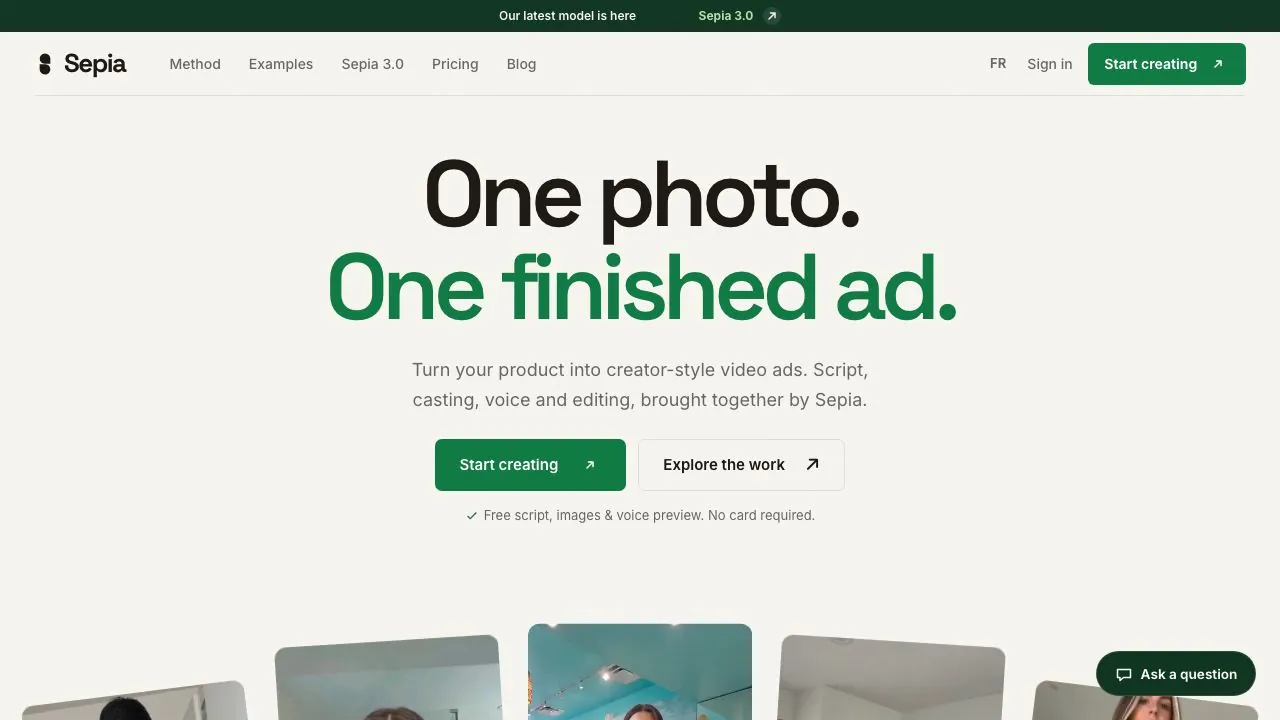
Sepia is a self-serve AI UGC ad tool operated by Jonathan Tapiero, doing business as SepiaLab, in Montreal, Quebec (stated in its Terms of Service). You upload a product photo and write a short brief; the platform writes hooks, casts an AI presenter it calls an 'ambassador', generates the footage, records a voiceover, and returns a cut, subtitled, mastered 9:16 video. There are no human creators and no product shipping. Billing is in credits: a short video is 30 credits and each extra hook variant is 5 credits, sold either as one-time packs or as four monthly subscription tiers. Every pricing card prints an explicit dollar-per-video figure rather than leaving buyers to divide credits by the 30-credit video cost. Sepia states that Sepia 3.0 is an orchestration layer rather than its own video model, with image and video generation running on third-party models picked shot by shot; its privacy policy names Replicate, Google and ElevenLabs among those providers, alongside AWS and Stripe. The homepage carries vendor-run claims this directory has not independently verified: a 'Part of NVIDIA Inception' badge, and a preference study Sepia labels 'Sepia study, n = 300, August 2026' in which it reports 75% chose Sepia over Higgsfield (20%), Arcads (5%) and HeyGen (0%). Sepia itself calls that a preference test rather than a technical benchmark, with method available on request.
What can Sepia do?
Photo-to-finished-ad pipeline
One product photo plus a short brief produces a cut, subtitled, music-scored, loudness-mastered 9:16 video. Sepia says it delivers a finished ad rather than clips to assemble.
Hook variants in series
Each generation opens on a different hook angle — Sepia names proof, curiosity, contrast and urgency — so openings can be tested in volume. A short video is 30 credits; each extra hook variant costs 5 more.
Per-video price printed on every tier
Each pricing card prints a dollar figure per video, from $9.00 pay-as-you-go down to $6.00 on Studio monthly and $5.00 on Studio annual, instead of leaving buyers to divide credits.
One-time credit packs
$18 for 60 credits or $45 for 150 credits behind a toggle on the same card, with no subscription. Both work out to $9.00 per video, and the card states these credits never expire.
Product consistency lock
Sepia says the uploaded product photo anchors every scene so the label stays readable and identical frame to frame while the presenter, set and framing change between hooks.
AI presenters, voice and lip-sync
Sepia casts an AI 'ambassador', generates a voiceover the homepage credits to ElevenLabs, and matches lip movement to the audio. No human creators are involved at any stage.
Orchestration over third-party models
Asked whether Sepia 3.0 is its own video model, the vendor's answer is 'No. Sepia 3.0 is the orchestration layer' — image and video generation run on third-party models picked shot by shot. Its privacy policy names Replicate, Google and ElevenLabs.
Free no-card preview
Script, images and voiceover can be previewed free without a card. Payment is required only to render the video.
Self-serve billing via Stripe
Checkout, plan changes and cancellation all run through the Stripe billing portal. Per the Terms, upgrades are charged prorated immediately and downgrades take effect at the next renewal.
Use cases
- DTC advertisers running hook-volume creative testing on TikTok, Reels and Shorts
- Buyers who want a single one-off purchase ($18 or $45) instead of committing to a monthly plan
- Teams that want per-video unit cost stated outright rather than back-solved from a credit allowance
- Small agencies feeding several brands — the Scale and Studio tiers list multiple brands and bulk generation
- Shopify and dropshipping sellers who have a product photo but no shoot or talent budget
Look elsewhere if
- Brands that need real human creators, physical product shipping, or genuine customer testimonials — every presenter, voice and scene is generated
- Creators looking for paid UGC work; Sepia has no creator side, no application page and no marketplace
- Buyers who need a contractual delivery time — the site publishes two different turnaround figures (about 10 minutes vs about 24 hours) and no SLA
- Teams that need refundable spend or a money-back trial of the finished video — all sales are final and the free preview stops before video render
- Procurement that requires an established vendor with references, a founding date, or verifiable third-party reviews — none of those exist for this platform
- Buyers who need unused monthly credits to reliably roll over, until the vendor resolves the contradiction between its pricing page and its in-app copy
Sepia pros and cons
Pros
- Unit economics are published rather than implied — every tier prints a dollar-per-video figure, from $9.00 pay-as-you-go to $5.00 on annual Studio
- A no-subscription entry point at $18 for 60 credits (~2 videos), with a $45 / 150-credit pack at the same $9.00 per video
- Free preview of script, images and voiceover with no card, so the output style can be judged before any spend
- The annual toggle shows the struck-through monthly price and the annual total ('billed $320/year'), so the discount is legible rather than disguised as a monthly rate
- Legal entity, tax numbers (NEQ 2281850307, GST/HST, QST), governing jurisdiction and a support email are published in the Terms
- Terms, Privacy and Refund policies are all public and dated July 15, 2026, and the privacy policy names the AI subprocessors (Replicate, Google, ElevenLabs) alongside AWS and Stripe
Cons
- The site contradicts itself on credit expiry: the pricing page says credits stack and never expire — and publishes that in its FAQ structured data — while the in-app string bundle shipped on the same page says plan credits reset each billing cycle and don't carry over, marking only pay-as-you-go credits 'permanent'
- The site contradicts itself on turnaround: the homepage says about ten minutes from upload to ready-to-post video, the Sepia 3.0 page says about 24 hours. No delivery SLA is published
- Printed per-video prices assume 30 credits and no extra hooks, but each additional hook variant costs 5 credits — so hook-series testing, the product's stated purpose, costs more per video than the card shows
- The percentage badges on each plan card (-11% to -44%) are savings against the $9.00 pay-as-you-go rate, not against monthly billing, and the page never says so — easy to misread as the annual discount
- All sales final: credit purchases and subscription payments are non-refundable including unused credits; a failed generation restores credits, never cash
- Output ownership is weaker in the Terms than in the marketing — the homepage says 'You own what you generate', the Terms qualify it as 'to the extent permitted by the applicable AI providers'
- No verifiable third-party review score: G2, Trustpilot and Capterra all returned 403, and the vendor's own Product Hunt listing shows zero reviews and no rating
- Almost no traction or scale evidence — no customer count, logo wall, case study, team page or founding date anywhere on the site; its claimed Product Hunt listing, launched 2026-07-19, shows 9 upvotes and 16 followers
- The footer's 'Prefer a fully managed service? Discover SepiaLab' link points to https://sepia-lab.com, the same self-serve homepage; no managed service or its pricing exists on the site
Sources consulted
as of 2026-09-20- sepia-lab.com (opens in a new tab)
- sepia-lab.com (opens in a new tab)
- sepia-lab.com (opens in a new tab)
- sepia-lab.com (opens in a new tab)
- sepia-lab.com (opens in a new tab)
- sepia-lab.com (opens in a new tab)
- sepia-lab.com (opens in a new tab)
- sepia-lab.com (opens in a new tab)
- sepia-lab.com (opens in a new tab)
- sepia-lab.com (opens in a new tab)
- producthunt.com (opens in a new tab)
Quick facts about Sepia
- Pricing
- Pay as you go (one-time credit packs)$18 one-time (60 credits, ~2 videos) or $45 one-time (150 credits, ~5 videos) — both $9.00 per videoStarter$32/mo billed monthly, or $27/mo billed annually (page shows 'billed $320/year')/moPro$72/mo billed monthly, or $60/mo billed annually (page shows 'billed $720/year')/moScale$198/mo billed monthly, or $165/mo billed annually (page shows 'billed $1980/year')/moStudio$480/mo billed monthly, or $400/mo billed annually (page shows 'billed $4800/year')/mo
All prices read off https://sepia-lab.com/en/pricing on 2026-09-20, with the page rendered in a browser so the two toggles could be read in both states. MONTHLY IS THE HEADLINE: the billing toggle loads with Monthly selected (aria-pressed="true"), so $32 / $72 / $198 / $480 are genuine monthly prices, not annual-equivalents. Clicking Annual ('2 months free') replaces each headline with a lower monthly-equivalent, strikes through the monthly price beside it, and adds an annual total: Starter $27/mo (was $32), 'billed $320/year'; Pro $60/mo (was $72), 'billed $720/year'; Scale $165/mo (was $198), 'billed $1980/year'; Studio $400/mo (was $480), 'billed $4800/year'. The page prints those totals without thousands separators, as reproduced here. Both one-time packs were read from the 60|150 toggle on the pay-as-you-go card: $18 / 60 credits / ~2 videos and $45 / 150 credits / ~5 videos, both '$9.00 / video'. DISCOUNT BADGES ARE NOT THE ANNUAL DISCOUNT: each plan card carries a percentage badge (-11%, -20%, -27%, -33% on monthly; -25%, -33%, -39%, -44% on annual). These are savings against the $9.00 pay-as-you-go per-video rate, not a saving against monthly billing, and the page never labels them. CONTRADICTION 1 (credit expiry, material to real unit cost): the pricing page states 'Credits stack month to month, and you can upgrade, downgrade or cancel anytime'; its explainer block says plan credits 'add to your balance, they do not expire'; a trust badge reads 'Credits never expire'; and the page's own FAQPage structured data publishes 'Credits are added to your balance every month and do not expire, so unused credits carry over.' But the in-app UI string bundle shipped inside that same page's payload reads 'Plan credits reset to your allowance each billing cycle. Unused plan credits don't carry over', and labels only pay-as-you-go credits '(permanent)'. If the in-app behaviour governs, unused subscription credits are lost each month and the effective per-video cost on an underused plan is higher than the printed figure. CONTRADICTION 2 (turnaround): the homepage stat block and homepage FAQ say '~10 min' / 'About ten minutes from upload to ready-to-post videos', while the Sepia 3.0 page FAQ says 'About 24 hours from upload to finished videos'. Both are published in FAQPage structured data. CONTRADICTION 3 (hook cost): every plan lists 'All hooks and variants' as an included feature, but the pricing header states 'A short video is 30 credits, each extra hook 5 credits'. The printed per-video prices assume 30 credits with no extra hooks, so testing hooks in series — Sepia's stated core use case — costs more per finished video than the card shows. Positioning is also inconsistent: the homepage meta description and the Sepia 3.0 page closing CTA both say 'Pay-as-you-go, no subscription', yet the pricing page opens with 'Pick a monthly credit plan' and four of the five options are subscriptions. Free preview: the homepage offers 'Free script, images & voice preview. No card required', and the pricing page adds 'You only pay to animate it into video', so the free step stops short of a finished video. Refunds: the Refund Policy (last updated July 15, 2026) states credit purchases and subscription payments are final and non-refundable including unused credits, except where law requires otherwise; a generation that fails for technical reasons restores credits, not cash. No enterprise or custom tier, and no minimum order, is published anywhere on the site.
- Ratings
No third-party ratings found on Trustpilot, G2 or Capterra.
- Turnaround
- Contradictory on the vendor's own site: the homepage and homepage FAQ say 'About ten minutes from upload to ready-to-post videos', while the Sepia 3.0 page FAQ says 'About 24 hours from upload to finished videos'. No SLA is published.
- Min. spend
- $18 one-time (60 credits, ~2 videos) is the smallest purchase offered. No minimum order, contract or enterprise tier is published; subscriptions cancel from the Stripe billing portal.
- Usage rights
- Every pricing tier lists 'Commercial license', and the homepage FAQ states 'Every export comes with a full commercial license, including paid ads on Meta, TikTok, YouTube and your own store. You own what you generate, with no per-use royalties or usage-rights fees.' Section 5 of the Terms of Service (sepia-lab.com/en/terms) is narrower: 'As between you and us, and to the extent permitted by the applicable AI providers, you own the videos and other content generated for you... and may use it for your commercial purposes once the corresponding credits have been paid.' Buyers also warrant they hold all rights to any brand, logo, product, trademark, person, voice or likeness in their inputs.
Frequently asked questions
The cheapest way in is a one-time credit pack: $18 for 60 credits (~2 videos) or $45 for 150 credits (~5 videos), both $9.00 per video with no subscription. Subscriptions are Starter $32/mo (120 credits, ~4 videos, $8.00/video), Pro $72/mo (300 credits, ~10 videos, $7.20/video), Scale $198/mo (900 credits, ~30 videos, $6.60/video) and Studio $480/mo (2,400 credits, ~80 videos, $6.00/video). Prices read on sepia-lab.com/en/pricing on 2026-09-20.
Yes. The pricing page loads with Monthly selected, so the headline prices are real monthly prices. Switching to Annual ('2 months free') shows a lower monthly-equivalent with the monthly price struck through and the annual total beside it: Starter $27/mo 'billed $320/year', Pro $60/mo 'billed $720/year', Scale $165/mo 'billed $1980/year', Studio $400/mo 'billed $4800/year'. Printed per-video cost on annual runs from $6.75 down to $5.00.
The site answers this two ways. The pricing page says credits stack month to month and do not expire, the pay-as-you-go card says 'These credits never expire', and the page's FAQ structured data says unused credits carry over. But the in-app interface copy shipped inside that same page reads 'Plan credits reset to your allowance each billing cycle. Unused plan credits don't carry over', and describes only pay-as-you-go credits as permanent. Ask Sepia directly before sizing a plan around rollover.
Also contradictory. The homepage and its FAQ say about ten minutes from upload to ready-to-post videos; the Sepia 3.0 page FAQ says about 24 hours from upload to finished videos. There is no published SLA or delivery guarantee.
Sepia says yes. Every tier lists a commercial license and the homepage FAQ says exports carry a full commercial license for paid ads on Meta, TikTok, YouTube and your own store, with no usage-rights fees. The Terms qualify ownership as holding 'to the extent permitted by the applicable AI providers', and require the corresponding credits to have been paid. Sepia also tells buyers to add the platform's AI disclosure label where required.
There is a free preview, not a free video: script, images and voiceover can be generated with no card, and payment is required only to render the video. There are no refunds — the Refund Policy states credit purchases and subscription payments are final and non-refundable including unused credits, and that a generation failing for technical reasons restores credits rather than money.
The Terms and Privacy Policy name Jonathan Tapiero, doing business as SepiaLab, NEQ 2281850307, in Montreal, Quebec, Canada, with support@sepia-lab.com as the contact. No founding date, team page, customer count or case study is published. Its claimed Product Hunt listing, first launched 2026-07-19, shows 9 upvotes, 16 followers and zero reviews.
No. Presenters, voices and scenes are all generated; there is no creator marketplace, no application page for creators, and nothing is shipped to a person to film. Sepia states Sepia 3.0 is an orchestration layer over third-party generation models rather than a video model it trained itself.
Alternatives to Sepia
Looking for a Sepia alternative? Compare these UGC platforms with similar use cases and verified pricing.
| Platform | Starting price | Model | Rating | Turnaround | |
|---|---|---|---|---|---|
| $18 | Credit-based | — | Contradictory on the vendor's own site: the homepage and homepage FAQ say 'About ten minutes from upload to ready-to-post videos', while the Sepia 3.0 page FAQ says 'About 24 hours from upload to finished videos'. No SLA is published. | Visit | |
| $110 /mo | Subscription | 2.7 out of 5 / 5 | Minutes per generated video (AI generation, no creator shipping/filming) | Visit | |
| $39 /mo | Credit-based | 4.8 out of 5 / 5 | Minutes per video (AI-generated; batch of up to 50 variations at once) | Visit | |
| $59 /mo | Credit-based | 2.8 out of 5 / 5 | Minutes per video (AI-generated; marketed as ~2 minutes from script to video) | Visit | |
| $16 /mo | Credit-based | 3.5 out of 5 / 5 | Minutes for credit-based renders; 'unlimited' queue renders reported at 6-68 hours | Visit |