"Agency" is the loosest word in this category. Of the six services ranked above, three sell what most buyers mean by it — someone else casts creators, ships product, writes or manages the brief, handles revisions, and hands back licensed, ready-to-run files. The other three sell something adjacent that gets filed under the same search term. Sorting them is the difference between a $30-per-post seeding program and a $12,400 production package.
The whole Managed UGC Services category exists because of one gap, and it is not creative quality.
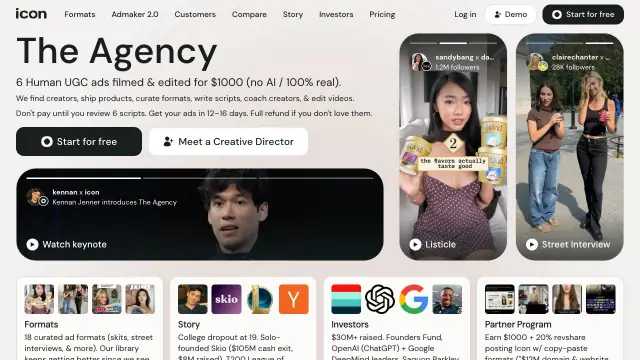
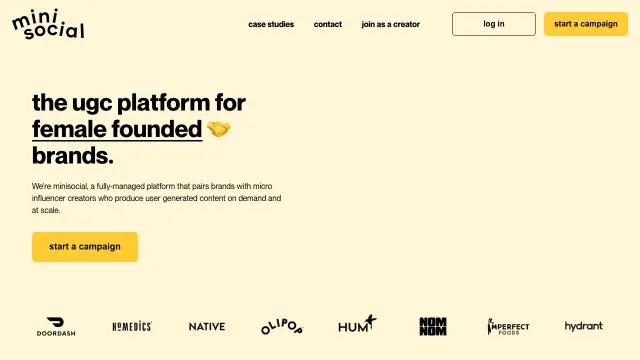
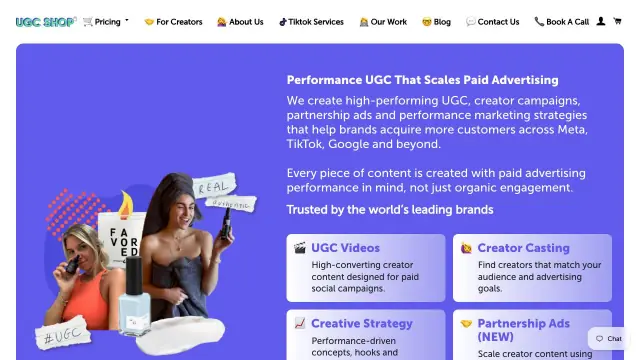
On a marketplace you write the brief, browse and select creators, ship product, chase delivery, review the cut, request revisions, and cut hooks yourself. A managed service absorbs most of that list. Icon sources creators from a stated 1,288+ vetted pool, ships your product, writes scripts within 24 hours, coaches creators through filming, and edits the videos, delivering 12–16 days after creators receive product. UGC Shop handles casting, shipping, and all creator communication, with concepts and creators pre-approved by you before anything is shot, delivered 7–10 business days after creators get the product. minisocial runs scouting, briefing, communication, and delivery; it publishes no official turnaround, and one documented creator-side campaign ran about 26 days end to end.
What you give up is creator selection. Icon assigns creators. minisocial has no self-serve browse for brands. UGC Shop lets you approve creators and concepts but not shop for them. If picking the face in the video matters to you, a managed service is the wrong shape regardless of budget.
Three of the six run the full done-for-you workflow. What separates them is who casts and who writes.
| Service | Who casts | Who writes the script | What lands in your folder |
|---|
| Icon | Icon assigns creators | Icon, within 24 hours | 6 edited ads a month, plus raw footage and B-roll |
| UGC Shop | UGC Shop matches, you pre-approve | UGC Shop, as concept development | Edited videos up to 35 seconds, one aspect ratio included |
| minisocial | minisocial scouts; no brand-side browse | Your brief, minisocial manages it | Licensed photo or video, plus the creator's own organic post |
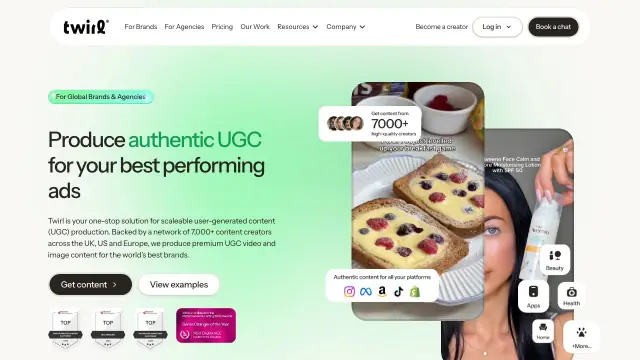
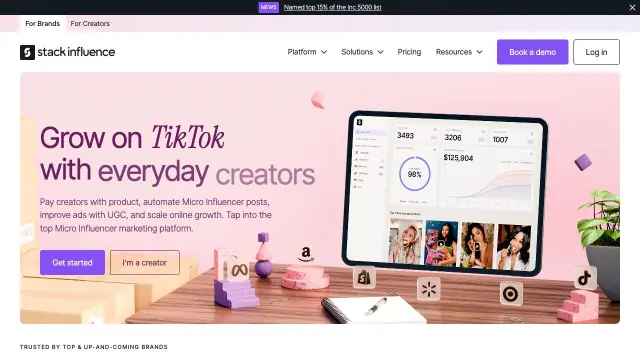
The other three land in this search term by intent, not by what they sell. Twirl's core product is pay-per-video self-serve — you brief through its dashboard and it matches creators from a 7,000+ pool across the UK, US, and Europe. Agency behavior starts only on the Creative Partner or End-to-End tiers, which carry monthly minimums — how that prices against Billo is the clearer read on whether the managed layer earns its markup. Stack Influence is fully managed, but the work it manages is product seeding for Amazon, Shopify, Walmart, and TikTok Shop listings: micro-influencers buy your product, get reimbursed, and post. That produces licensed content cheaply, but it is not scripted ad production. Cohley is classed a UGC marketplace in our records, and its own answer to "marketplace or agency" is "both, depending on plan" — Managed Services is a paid tier bolted onto the platform license, while the Platform Plan leaves briefing and creator selection with your team. Do not buy any of the three expecting the Icon or UGC Shop workflow.
Four shapes, all documented in the platforms' own materials.
Monthly minimums stacked on per-unit fees. Twirl's Creative Partner tier is $550 (£400/€460) per concept plus video costs, with a minimum of £1,500 / $2,000 / €1,600 a month on a three-month commitment that then goes rolling. End-to-End is $950 (£700/€800) per concept plus video costs, minimum £2,100 / $2,800 / €2,240 a month. The per-concept fee and the monthly floor are separate, and neither covers the videos.
Package minimums that are final. UGC Shop's entry is $850 for 2 videos from 1 creator. Its own FAQ says packages are non-refundable, refunds are refused if the brand omitted information from the brief, exactly one revision round is included, and reshoots are declined unless UGC Shop made a documented brief error. Each additional aspect ratio costs $50 per video, and the hook-variation add-on on the Scale tier is $600.
Trials that convert. Icon bills as "$0 today, $1,000/mo after 3 days" — the trial auto-converts to a recurring subscription. Icon states you review 6 scripts before paying and offers a money-back guarantee, but Trustpilot reviewers report difficulty cancelling and charges after cancelling, and Icon's Trustpilot sentiment sits at 4.0/5 across 75 reviews.
No rate card at all. Cohley publishes nothing: every plan is a custom, sales-led quote, and Capterra lists no free trial. Stack Influence advertises a "$30 flat fee average per creator post" with $0 monthly platform fees, but exact per-post pricing requires a demo, no minimum campaign size is published, and you supply the product on top of the fee.
Run the per-asset math before the sales call. Icon works out to roughly $167 per finished ad. minisocial is $300 per creator at the entry tier. UGC Shop lands at $425 a video on the $850 Trial package and $600 a video on the $2,400 Growth package — buying the next tier up costs more per video, not less; only the $6,300 Scale package pulls it back to $525.
Two documents about the same platform do not always agree, and the gap matters before you negotiate.
- Icon. Third-party reviews reference a legacy $39/mo self-serve software tier and managed plans from $1,500/mo. Icon's current pricing page lists only the $1,000/mo Agency plan. Treat the other figures as historical; the product has repositioned twice in about 18 months.
- minisocial. Its own homepage and FAQ give $3,000 for 10 creators. An older third-party listing (1800dtc.com) cites $2,500 for 25 creators plus a 15% first-project discount. The two are not reconcilable — take the platform's own number and get any discount in writing.
- Twirl. Bulk pricing of roughly $275/video at 10 videos and $230 at 30 comes from Influee's comparison article, not from Twirl's pricing page. Ask Twirl directly.
- Cohley. The frequently repeated $200–$500+ per video and $2,000–$5,000+/month for about 10 videos are third-party estimates, not numbers Cohley publishes.
On review depth: our records find no verifiable Trustpilot, G2, or Capterra presence for minisocial, UGC Shop, or Twirl, so their quality case rests on their own testimonials. Cohley carries 4.4/5 from 70 G2 reviews. Stack Influence carries 4.6/5 from 542 Trustpilot reviews, but with no verifiable G2 or Capterra presence, buyer-side experience is hard to validate; the complaints on that page are creator-side, about automated rejections and disputed reimbursements.
Your total budget is under $850. That is below the cheapest true done-for-you entry in this list. JoinBrands runs $25 per video plus a 15% platform fee (about $29–$69 all-in on the Free plan), soona UGC is $89 a video with perpetual worldwide rights and ~7-day delivery, Clip is $124, and Billo is $99 nominally but typically $120–$250 once add-ons are counted, funded through a ~$500 minimum credit pack whose unused balance expires.
You want one or two test videos. minisocial's $3,000 project and Twirl's four-video first-order minimum (~$1,300) both force volume you may not need yet.
You already employ the labor. The agency premium is mostly project management. If you have a media buyer and an editor, Insense at $400/mo billed annually plus a 7–20% creator fee buys the pipeline and leaves the work with your team, and Collabstr is free to browse at the creator's listed rate plus a 10% hiring fee.
You want to choose the creator. Every managed option here assigns or pre-selects for you.
The agency case is the mirror image: buy managed when your internal hours cost more than the markup, when you need one vendor accountable for the whole chain, or when you need distribution rather than files — minisocial's creators post to their own audiences and each project includes 30 days of whitelisting, and Stack Influence's model is reach-and-seeding by design.
How many revision rounds are included, and what counts as one? (UGC Shop: one. Twirl: two. Icon: unlimited.) Is the package refundable? How many aspect ratios ship in the base price? Do you receive raw footage, or only the final cut? (Icon includes raw footage and B-roll.) How long is the commitment? Twirl's managed tiers run a three-month minimum; Cohley typically requires an annual one. And finally: what happens if the creator match is wrong? That answer, more than the headline price, is what separates an $850 package from an $850 loss.