
GRIN vs Aspire: Which Should You Pick?
grin.co · aspire.ioPrices verified Sep 2026
Researched by Gan Liu · Founder & lead researcher
Our verdict
Pick GRIN if you live in Shopify and want to start cheap: it has a free tier, paid plans from $200/mo, takes no cut of creator deals, and its discount-code/seeding/GMV tooling is the deepest here (G2 4.5/5, 483 reviews). Pick Aspire for managed, always-on programs at mid-market scale: ~$1,000-$2,000/mo billed annually with dedicated account reps that reviewers consistently praise (G2 4.6/5, 144 reviews). Both carry contract risk — GRIN has a documented history of 12-month lock-ins sold through misleading demos, and Aspire mandates annual billing with no trial — so negotiate exit terms in writing with either.
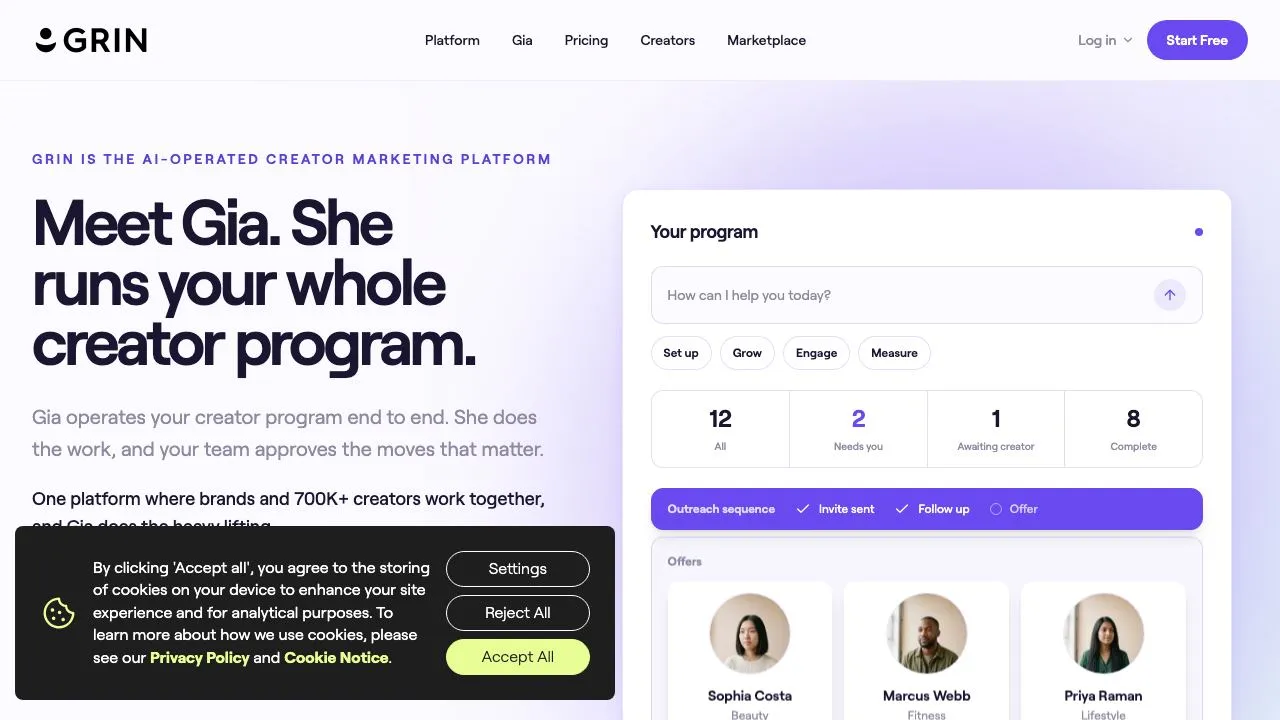
- DTC/ecommerce brands on Shopify running always-on influencer seeding and affiliate programs
- Mid-market brands managing 100+ creator relationships who need CRM-style workflow, not a one-off marketplace
- Teams that want affiliate/discount-code revenue attribution without paying a commission on GMV
- Stronger on pricing and shopify/ecommerce integration
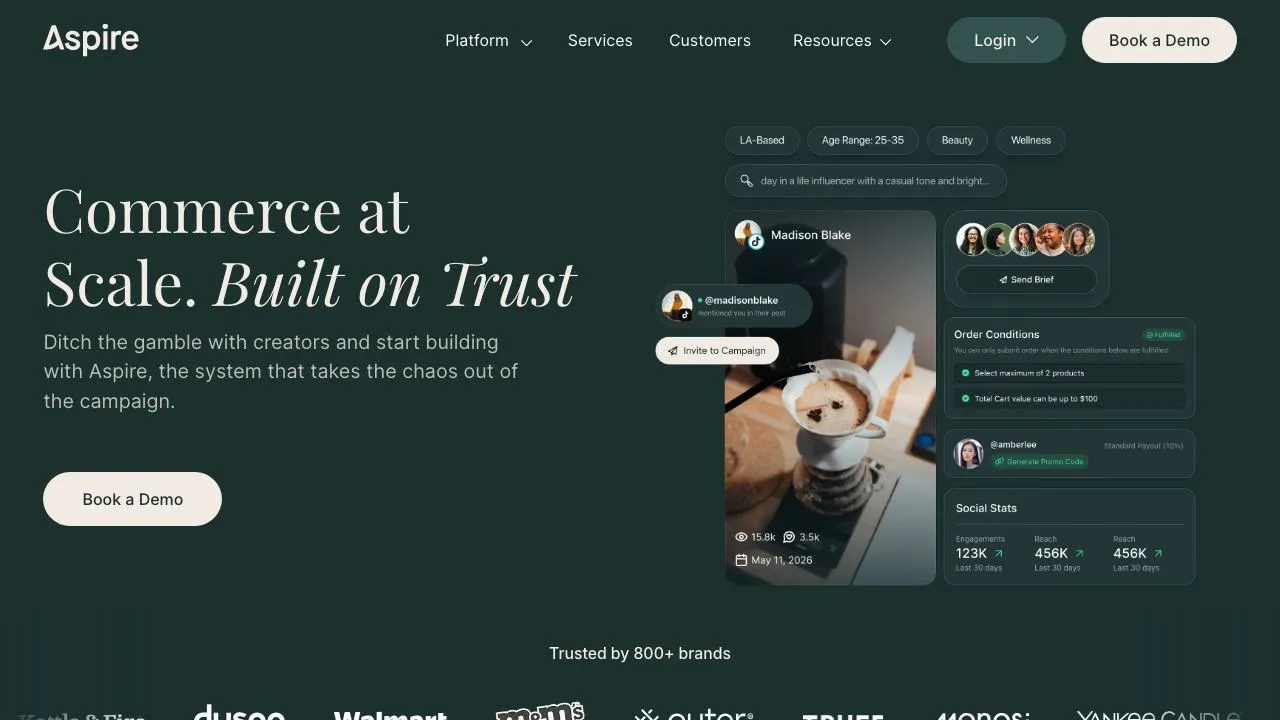
- Mid-market and enterprise ecommerce brands running always-on influencer programs at scale
- Shopify DTC brands that want product seeding, affiliate links, and sales attribution in one tool
- Teams that want to turn influencer content into paid ads (allowlisting/Spark-style amplification)
- Stronger on managed service
GRIN vs Aspire at a glance
Scroll the table sideways to see both columns.
| Dimension | GRIN | Aspire |
|---|---|---|
| Pricing | Free tier; paid from $200/mo; no take rate on creator dealsWinner | ~$1,000-$2,000/mo, annual billing mandatory, no trial |
| Shopify/ecommerce integration | Deepest: codes, affiliate links, seeding, GMV tracking nativeWinner | Strong Shopify seeding and conversion tracking |
| Managed service | Self-serve platform; 'curated lists' add-on criticized as delivering irrelevant influencers | Dedicated account reps consistently praised in reviewsWinner |
| Usage rights | Negotiated per creator via contract tools; no platform fee on rights | Negotiated per campaign through contract and approval workflows |
| Creator vetting | Discovery is on you; support delays reported in negative reviews | Capterra reviewers report influencers vanishing after free product; Aspire says it can't enforce behavior |
| Contract risk | Documented 12-month lock-in and auto-payment complaints from sales-demo era | Annual lock-in by design; slower support outside account reps |
| Best for | Shopify DTC brands scaling creator programs on a budget | Mid-market/enterprise brands wanting managed always-on influencer ops |
Both are creator-relationship platforms for ecommerce brands, both founded in 2014, both selling discovery, seeding, affiliate codes, and Shopify sales attribution from one workspace. The decision underneath is not features. It is whether you are allowed to find out what the thing costs before you are bound to it. GRIN publishes a rate card and a free plan you can run indefinitely without a credit card or a sales call. Aspire publishes nothing — aspire.io/pricing returns a 404, every figure comes out of a demo, and the contract is annual with no trial and no month-to-month option. That asymmetry settles more purchases than any feature grid will.
The pricing math, and the point where it stops being math
GRIN's 2026 model is credit-metered and fully checkable from the published plans:
| GRIN plan | Price | Credits/mo | Cost per credit | Active creators (GRIN Classic) |
|---|---|---|---|---|
| Free | $0 | 200 | — | — |
| Starter | $200/mo | 2,000 | $0.100 | — |
| Growth | $500/mo | 7,500 | $0.067 | up to 100 |
| Scale | $1,000/mo | 20,000 | $0.050 | up to 250 |
| Complete | $1,500/mo | 30,000 | $0.050 | up to 500 |
Two things fall out of that table that the pricing page does not spell out. Overage is $0.10 per credit on every paid plan — identical to Starter's included rate — so on Scale or Complete each credit past the allowance costs double what the same credit costs inside it. The hard cap is user-set; set it. And the per-creator math improves as you climb: Growth is $5 per active creator per month at its 100-creator ceiling, Complete is $3 at 500. If the program is genuinely large, the expensive plan is the cheaper one.
Aspire cannot be costed this way, and its sources contradict each other. Third-party reporting puts entry at $1,000-$2,000 a month billed annually — a $24,000/yr floor at the commonly repeated $2,000 figure. Vendr's procurement benchmarks show actual contracts from $11,139 to $36,599 a year, median $15,588: a floor near $928 a month, below what the review sites keep citing. Capterra lists $2,499 per user per month, about $29,988 a year for one seat, reconciling with neither. Vendr also records a negotiable 2% service fee on some contracts. Three sources, three incompatible numbers, and only a sales call resolves them.
Set them against one annual figure. Vendr's Aspire median of $15,588 buys twelve months you cannot exit. The same money buys ten months of GRIN's top Complete plan — 30,000 credits, up to 500 active creators — cancellable at any point. GRIN's Growth plan runs $6,000 a year, below the cheapest Aspire contract in Vendr's dataset.
The structural trade: an agent you meter, or a rep on your account
GRIN rebuilt itself in 2026 around Gia, an AI agent trained on $1B+ in partnership data that runs discovery, outreach, and program execution against a marketplace of 700K+ creators. Credits are how you pay for that agent's work. It is software you operate — and when GRIN sells you humans instead, through the paid "curated lists" service, that is the piece reviewers single out for delivering irrelevant or duplicate influencers.
Aspire attaches a person to the software instead. Its dedicated account reps draw consistently positive mentions in its reviews, and it carries 800+ brands including Walmart, Samsung, and HelloFresh, with $100M+ paid out to creators. Managed-service add-ons sit on the Enterprise tier alongside dedicated account management, so the hands-on layer is real but sold at the top. The praise is also specific to the reps; broader support outside them is called slow or unresponsive in the same reviews. Account management is headcount attached to your account, and it is quoted per deal rather than published.
GRIN's cheap path assumes you operate the agent yourself; the free and $200 tiers buy credits, not people. Aspire's floor is a five-figure annual contract that carries a rep with it. If nobody on your team has the hours to run discovery, briefs, and follow-up, GRIN's headline price advantage narrows to whatever your own time is worth.
Neither GRIN nor Aspire bundles usage rights
Usage rights are bundled by neither. GRIN's are negotiated with each creator through its contract tools, with no platform fee on the deal. Aspire's are negotiated per campaign through its contract and approval workflows, explicitly not at a flat platform rate. Arriving from a per-video marketplace where rights land automatically on approval, budget for the negotiation and the admin on both. If you have not had to negotiate rights per creator before, that page lists the clauses to settle first.
Take rate. GRIN charges no commission or transaction fee on affiliate links, discount codes, or GMV tracked through the platform, on any plan including free. Our sources do not state Aspire's position either way — the only fee figure on record is Vendr's negotiable 2%. Ask before signing.
Seeding fraud. Capterra reviewers report Aspire influencers disappearing after receiving free product, with Aspire responding that it cannot monitor or enforce influencer behavior. Read that twice before funding a large seeding push. GRIN's failure mode is different: discovery is yours to run, and negative reviews cite support replies taking a week or more, some issues open for months. Aspire creators also report a five-application-per-month cap until they earn 4-5 star reviews, which skews your inbound applicants toward platform regulars.
Contract exit is the asymmetric risk, and the review data needs care. Aspire's annual lock-in is by design. GRIN's is history — reviewers describing 12-month contracts sold through misleading demos, auto-payments that were hard to stop, and refused refunds are describing the legacy annual model the 2026 overhaul replaced. That reframes GRIN's Trustpilot standing without excusing it: 3.2/5 with 48% one-star on only 31 reviews, against 4.5/5 on G2 (483) and 4.7 on Capterra (148). Aspire has no Trustpilot record in our dataset at all, and its 3.5/5 on Capterra rests on six reviews next to 4.6/5 on G2 (144). Missing complaint data is not evidence of better conduct. Treat all of it as third-party sentiment, not measurement, and get exit terms in writing either way.
GRIN if you can start at $0, Aspire if you need a rep
Both sit in the influencer platform category rather than the UGC marketplaces: they manage creator relationships, they do not sell you videos. Choose GRIN if you sell on Shopify, want codes, affiliate links, seeding, and GMV attribution native, and want to prove the channel at $0 first — the free plan carries 200 Gia credits a month with every Gia capability included, pauses billable actions rather than charging for them, and new accounts get a one-time 500-credit bonus. Do not choose GRIN if you want someone else to run the program, if you have no store to integrate against, or if you only need a few UGC videos, where a per-video marketplace is dramatically cheaper.
Choose Aspire if you are mid-market or enterprise, running always-on programs across hundreds of creators, using CreatorAds allowlisting, and you specifically want a dedicated rep — that is the part reviewers name most consistently, and the part GRIN's self-serve model does not sell you. Do not choose Aspire if you are small, if cash flow cannot absorb a five-figure annual commitment, if you still need to prove the channel works, or if all you want is creator search.
The blunt version: GRIN lets you find out. Aspire makes you commit to find out.
Quick facts about GRIN
- Pricing model
- Subscription
- Starting price
- $0(free tier); paid plans from $200/mo
- Free trial
- Yes
- Minimum spend
- $0 (free tier); $200/mo for the cheapest paid plan
- Usage rights
- Content rights are negotiated directly with creators via GRIN's contract and content-management tools; GRIN itself does not charge a fee or take rate on deals, but usage-rights costs are whatever the brand agrees with each creator.
- Founded
- 2014
- Headquarters
- Sacramento, USA
- Ratings
- 4.5 out of 5(483 reviews)on G24.7 out of 5(148 reviews)on Capterra3.2 out of 5(31 reviews)on Trustpilot
Pricing verified 2026-09-02 — may change.View official pricing
Quick facts about Aspire
- Pricing model
- Custom quote
- Starting price
- ~$1,000-$2,000/mo(custom quote, billed annually)
- Free trial
- No
- Minimum spend
- ~$11,000-$24,000/yr platform contract (annual billing required), plus creator payments and product costs
- Usage rights
- Usage rights and licensing terms are negotiated per campaign with each creator through Aspire's contract and content-approval workflows; not bundled at a flat platform rate
- Founded
- 2014
- Headquarters
- San Francisco, USA
- Ratings
- 4.6 out of 5(144 reviews)on G23.5 out of 5(6 reviews)on Capterra
Pricing verified 2026-09-02 — may change.View official pricing
Frequently asked questions
As of 2026, GRIN offers a free plan (200 monthly Gia credits, unlimited CRM, and a commission-free affiliate program) and paid plans at $200, $500, $1,000, and $1,500 per month, billed month-to-month with no annual contract. Overage on paid plans costs $0.10 per credit under a user-controlled cap. Older sources citing $25K+ annual contracts describe GRIN's legacy pricing model.
GRIN no longer needs one — the Free plan is the trial. It requires no credit card or sales call and includes every Gia capability with 200 credits per month, so you can run a small program indefinitely at no cost.
No. GRIN charges no take rate or transaction fees on affiliate links, discount codes, or GMV tracked through the platform on any plan. You pay only the subscription and any credit overages.
Aspire does not publish pricing; you must book a demo for a quote. Third-party sources report entry points around $1,000-$2,000/month billed annually, and Vendr benchmarks show contracts ranging from about $11,139 to $36,599 per year with a median of $15,588.
No. Multiple third-party reviews confirm there is no free trial and no month-to-month option — plans require an annual contract negotiated via sales.
Yes. The company was founded in San Francisco as Revfluence (circa 2013-2014), rebranded to AspireIQ in 2018, and now operates simply as Aspire at aspire.io.
Sources consulted
as of Sep 2026- grin.co (opens in a new tab)
- grin.co (opens in a new tab)
- trustpilot.com (opens in a new tab)
- g2.com (opens in a new tab)
- capterra.com (opens in a new tab)
- crunchbase.com (opens in a new tab)
- flinque.com (opens in a new tab)
- influencer-hero.com (opens in a new tab)
- modash.io (opens in a new tab)
- ainfluencer.com (opens in a new tab)
- aspire.io (opens in a new tab)
- g2.com (opens in a new tab)
- capterra.com (opens in a new tab)
- vendr.com (opens in a new tab)
- tracxn.com (opens in a new tab)
- crunchbase.com (opens in a new tab)
- modash.io (opens in a new tab)
- influencer-hero.com (opens in a new tab)
- creator-hero.com (opens in a new tab)
- stackinfluence.com (opens in a new tab)
- getapp.com (opens in a new tab)
Weighing more than these two? Best UGC Platforms for Established Brands ranks GRIN, Aspire and the rest side by side.
Not convinced by either? Alternatives
- 4.6out of 5 on G2~$478/mo
Upfluence
All-in-one influencer and affiliate marketing platform with a 12M+ creator database
- 5.0out of 5 on Shopify App Store$299/mo
Modash
Shopify-first influencer discovery, CRM and creator-payout platform; $299/mo month-to-month, $199/mo billed annually.
- 4.7out of 5 on G2$499/mo
#paid
Creator marketplace matching vetted influencers with brands for content and paid ads