
makespots
makespots.com(opens in a new tab)AI ad studio: find viral templates, edit the workflow on a canvas, ship ads in minutes
Researched by Gan Liu · Founder & lead researcher
(800 credits, ~10 standard 5-second clips)
Opens makespots.com in a new tab
Buy it if you want published pricing, an editable workflow canvas, and a real no-card trial — and can live without a third-party review record yet.
Best for ecommerce and D2C teams that want published pricing and predictable per-ad cost
Skip it if teams that need a deep library of photorealistic AI actors (Arcads)
What is makespots?
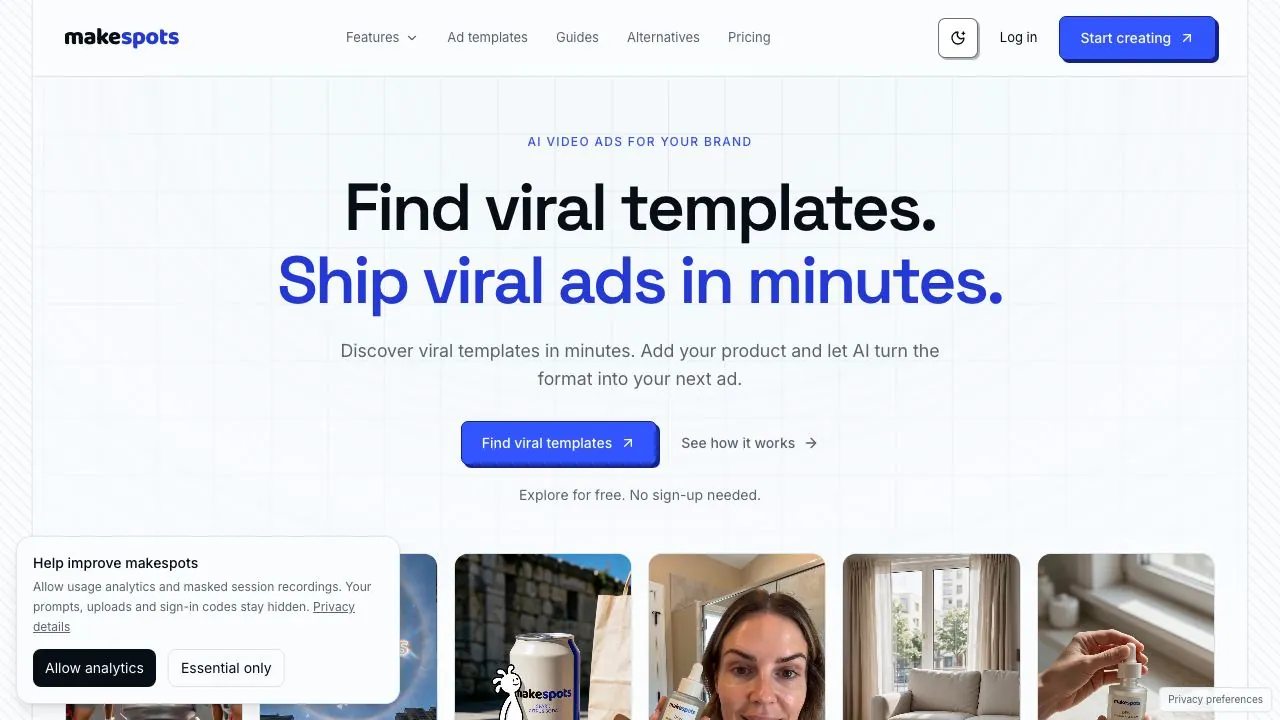
makespots is an AI ad studio that turns product photos and brand assets into video and image ads through a template library of product ads, UGC clips and animations. Its differentiator is the editable workflow: every template opens as a node-based canvas where text, image-generation and video-generation steps can be changed and re-run, so a winning format can be reused for the next product instead of re-briefing from scratch. Pricing is fully published, and the workspace shows an exact credit quote before any generation starts.
What can makespots do?
Template library across product ads, UGC and animation
Hundreds of formats — product reveals, UGC selfie clips, animated spots and image ads — each previewed with a real example video before use.
Editable workflow canvas
Every template opens as a node-based workflow (text, image generator, video generator steps) that can be edited, reconnected and re-run, so a winning format carries over to the next product.
Exact credit quote before generation
Saved projects get a precise credit quote before generation starts; the reservation is charged on success and released on confirmed failure.
Product customization
Add a product photo and brand details; the template keeps its creative direction with your product in the spotlight.
Your assets library
Product photos, clips and references stored once and reused across every creative.
Projects & variations
Save projects and produce fresh variations of an ad by swapping inputs in the same workflow.
Use cases
- Ecommerce and D2C teams that want published pricing and predictable per-ad cost
- Creative teams that want to edit the workflow, not just re-prompt
- Small teams testing their first AI UGC ads with a no-card trial
Look elsewhere if
- Teams that need a deep library of photorealistic AI actors (Arcads)
- High-volume batch creative at 50 variations per run (Creatify)
- Buyers who require a long third-party review history before purchase
makespots pros and cons
Pros
- Publishes its full rate card — no paywall, no sales call
- Free trial of 160 credits (about two real clips) with no card and no auto-subscription
- Exact credit quote before every generation, charged only on success
- Editable node-based workflows instead of black-box generation
- Cancel renewal anytime; unused allocations refundable within 7 days
- Monthly credits last 2 calendar months; one-time packs last 12
Cons
- No third-party review record yet (no Trustpilot, G2 or Capterra profile)
- Monthly credits expire after 2 calendar months
- Commercial use of output is subject to the underlying model provider's terms
- Standard baseline is 5 seconds; longer clips burn 16 credits per second
- Concurrency is capped at 1-3 generations depending on plan
Our makespots review
Our editorial score — not an average of the third-party star ratings in the sidebar. Built from makespots’s published pricing, contract and help center, with third-party reviews read for complaint patterns rather than their averages, and not from a paid hands-on test. Every price and quoted term was checked on 2026-11-11.
TL;DR: makespots publishes its entire rate card (pricing page (opens in a new tab), verified 2026-11-11): a standard 5-second clip costs 80 credits, longer clips add 16 credits per second, and images start at 5 credits. Starter is $29/mo for 800 credits, so a standard clip works out to $2.90 — and the workspace shows an exact quote before any generation starts. The free trial is real: 160 credits, valid 7 days, no card, no auto-subscription. The trade-off is youth: there is no Trustpilot, G2 or Capterra record yet, and commercial use of output rides on the underlying model provider's terms.
makespots turns product photos and brand assets into video and image ads. Its homepage pitch is "find viral templates, ship ads in minutes" (makespots.com (opens in a new tab), verified 2026-11-11), and its mechanism is different from the category's two incumbents in one specific way: instead of a script-to-video black box (Arcads) or URL-to-video automation (Creatify), every template opens as a node-based workflow — text, image-generation and video-generation steps connected on a canvas — that you can edit and re-run. Pick a format, drop in your product, change what you want, and the winning format carries over to your next product instead of being re-briefed from scratch.
The templates span product ads, UGC clips, animations and image ads, with named examples like Volcano Blast, UGC Selfie Line Clip, Hands-Only Product Demo, Space Assembly Animation, 3D Billboard, Mid-Air Commercial Hero and 80s Product Ad. Guests can browse everything and try inputs without signing up — "Explore for free. No sign-up needed" — and the free trial does not ask for a card.
This review does not rank the output quality — we have not run generation on any platform, makespots included. It answers the question that actually blocks a purchase in this category: what exactly are you paying, what do the terms say, and what does a shipped ad really cost?
How We Verified This
We did not buy a makespots subscription. CompareUGC does not run paid hands-on tests. Instead, this review is built from four layers of evidence you can re-check in about ten minutes:
Layer 1: documents of record. The homepage, pricing page (opens in a new tab) and terms of service (opens in a new tab) were pulled on 2026-11-11 and are quoted directly with links. The terms were last updated 2026-11-10, one day before verification.
Layer 2: credit math, rebuilt. The rate card publishes a cost per output; we rebuilt the cost per shipped ad, per plan, including the length scaling the pricing page discloses. Every line is marked QUOTED (official source) or ESTIMATED (our assumption, stated).
Layer 3: the terms, clause by clause. Usage rights, refunds, expiry, cancellation and the credit-reservation mechanics — the places where a platform's paperwork costs or protects you.
Layer 4: disqualifiers. The buyer profiles the documents rule out.
One relationship we state plainly here: makespots is operated by Jincove, which also operates CompareUGC. makespots is scored against the same published rubric as every other platform — the deductions below are the same list /how-we-score publishes for Arcads, Creatify and the rest — and this page is the only place that relationship matters to the numbers.
What Makespots Actually Costs in 2026
Everything is public. The rate card (pricing page (opens in a new tab), verified 2026-11-11):
| Plan | Price | Credits | Standard clips | Large product images | Concurrency |
|---|---|---|---|---|---|
| Free trial | $0, once | 160, valid 7 days | ~2 | — | — |
| Starter | $29/mo | 800/mo | ~10 | ~80 | 1 at a time |
| Pro | $59/mo | 2,400/mo | ~30 | ~240 | 2 at a time |
| Scale | $119/mo | 5,600/mo | ~70 | ~560 | 3 at a time |
A "standard" clip is 5 seconds, QUOTED: "STANDARD VIDEO — 80 credits / 5 seconds — Seedance 2.0 · 720p · no video references. Longer clips use 16 credits per second." Product images start at 5 credits each (Seedream Pro), and "extra inputs, longer videos and premium models use more credits." The plan pages also quote one-time packs of $15 for 300 credits and $45 for 1,000.
Per-credit cost falls with plan size: $0.036 at Starter, $0.025 at Pro, $0.021 at Scale. A standard clip therefore costs $2.90 on Starter, $1.97 on Pro and $1.70 on Scale. That is the cheapest 5-second entry point in the category that publishes a price at all — Arcads' comparable number sits behind an account wall at roughly $11, and Creatify's 15-second standard is $1.95 on Starter but with opaque agent-layer burn.
The length scaling is where the math turns. At 16 credits per second past the fifth:
| Clip length | Credits | Starter cost | Pro cost | Scale cost |
|---|---|---|---|---|
| 5s (standard) | 80 | $2.90 | $1.97 | $1.70 |
| 15s | 240 | $8.70 | $5.90 | $5.10 |
| 30s | 480 | $17.40 | $11.80 | $10.20 |
| 60s | 960 | $34.80 | $23.60 | $20.40 |
So Starter's 800 credits buy ten 5-second hooks, or 1.7 thirty-second ads, per month. Pro buys five 30-second ads; Scale buys 11.7. makespots is built for the short-hook economy — the format its own template library overwhelmingly showcases — and gets proportionally expensive as clips stretch toward a minute. That is not hidden: the quote mechanism makes it visible before you generate. But it is the single most important number to internalize before subscribing, because it reshapes which plan you should buy (see the verdict).
The free trial, QUOTED from the pricing page: "160 credits, once. Claim after verifying your email · valid 7 days. Up to 2 standard 5-second video clips. Template previews and workflow canvas. No card. No automatic subscription." Two real clips is enough to judge output quality, which is more than the category's $110-per-month incumbent offers at any price.
The Quote-Before-You-Generate Mechanism
The pricing page makes a claim worth reading twice: "Your saved project gets an exact quote before generation starts," and "Cost before you generate." The terms then describe the mechanics behind it (terms, section 3 (opens in a new tab), verified 2026-11-11):
"A run reserves its quoted maximum credits before starting. Successful work is charged according to the confirmed run; confirmed failures release the reservation. If a provider outcome is uncertain, credits stay reserved pending review so that the same paid request is not submitted twice."
Translated: the platform tells you the worst case before it spends your money, charges the confirmed amount, and does not bill you for a failure it can confirm. In a category where Creatify's help center says agent-layer consumption "is variable and cannot be determined upfront" and Arcads rounds every video up to a full minute and bills re-generation again, this is the best consumer mechanics of any AI UGC platform we have reviewed. It does not guarantee a usable ad — nothing does — but it guarantees you see the price first, and the site-wide slogan "Cost before you generate" is enforceable, not marketing.
One honest caveat on trial math: the 160 credits must be claimed after verifying your email, are valid for 7 days, and are limited to one claim per account and verified email identity. This is a trial designed to survive abuse, not a permanent free plan — Creatify's watermarked monthly free tier remains the only ongoing $0 option in the category.
The Workflow Canvas
The differentiator that does not fit in a pricing table: templates are editable workflows, not finished renders. The homepage describes it as "See how your ad is made. Connect product images, prompts, and video steps on one canvas. Keep what works and change what's next," with node types of text, image generator and video generator. Practically, that means:
- A template is a pipeline you can inspect — which image feeds which video step is visible, not inferred.
- A winning format is reusable: swap the product photo and re-run instead of re-describing the creative from zero.
- The canvas supports steps being added, removed and reconnected, with grouped undo/redo and connection validation — an editing model closer to a video editor's timeline than to a prompt box.
The product-customization layer fits the same philosophy: "Add a product photo and your brand details. Keep the creative direction, with your product in the spotlight," backed by an assets library where uploaded photos, clips and references persist across creatives, and a projects-and-variations system for producing the next version of an ad.
What the platform does not have: a photorealistic AI actor library. Arcads sells 1,000+ talking-head actors with emotion control; makespots sells formats — product reveals, UGC-style clips and animations — that do not depend on a synthetic human delivering a script. If a talking-head actor is the requirement, this is the wrong tool, full stop. If the requirement is "make this product look like the ads that are working," the template-to-workflow loop is the point.
The Terms, Clause by Clause
Usage rights (terms, section 2 (opens in a new tab), verified 2026-11-11): "You keep your rights to the content you upload. You give us and the providers needed for your chosen workflow permission to process and store that content to deliver the service." On output: "You may use generated results commercially to the extent permitted by the relevant model provider and applicable law." Uploaded assets are cleanly yours; output rights are bounded by the model provider's terms rather than unconditionally assigned. The terms also explicitly refuse to promise uniqueness or advertising performance — "We do not guarantee unique results or advertising performance" — which is the honest version of what every vendor in this category implies. The provider-terms boundary is a real deduction against a full-assignment license, but it is disclosed rather than buried, and nothing in the terms takes your uploaded content away from you.
Refunds (terms, section 4 (opens in a new tab), verified 2026-11-11): "For an unused subscription allocation or unused credit-pack purchase, request a refund within 7 days of payment by emailing [email protected] from your account address. Consumed credits and completed generation are normally non-refundable." A seven-day window on unused allocations is a genuine refund policy — the category's typical answer is "payments are final and non-refundable" (Creatify) or a refund contingent on producing a cancellation-confirmation email (Arcads). It does not cover consumed credits, and it requires you to notice within a week, but money can come back in the common case of a mistaken or premature purchase.
Expiry (terms, section 3 (opens in a new tab), verified 2026-11-11): paid monthly allocations "expire two calendar months after the billing period starts," and one-time packs last 12 months. Two months of float is friendlier than monthly-reset models and matches Creatify's published FAQ; it is still a deduction — money paid is money with a fuse.
Cancellation (terms, section 4 (opens in a new tab), verified 2026-11-11): "Cancel renewal at any time from Settings → Billing → Manage subscription. Cancellation takes effect at the end of the current paid period." No minimum commitment, no penalty, no annual-only pricing trap — the entire rate card is monthly in USD. Existing credits retain their expiry dates after cancellation.
Training and data (terms, section 2 (opens in a new tab), verified 2026-11-11): the processing permission granted is "to deliver the service." The terms contain no licence to train models on your content and no irrevocability clause over it. Under the rubric's AI-training-rights deduction this earns credit rather than costs it.
Account risk (terms, section 5 (opens in a new tab), verified 2026-11-11): the platform "may change available models, improve features or pause access to address abuse, security incidents, provider outages or non-payment," with a commitment to "explain material changes that affect an active purchase where practical." Standard discretionary language — every platform in the category reserves this — but the terms name the triggers rather than hiding behind a generic clause.
What is not there: the terms carry no governing-law, liability or arbitration detail, and there is no third-party review profile anywhere — no Trustpilot, G2 or Capterra listing as of 2026-11-11. For a new platform that is a neutral fact rather than a finding; under this site's rubric, "no record" is scored as the absence of evidence it is, while a documented complaint pattern is scored worse. The buyer who requires a long public track record before spending is disqualified by the date, not by the documents.
Who Should Not Buy Makespots
Do not buy makespots if your ad library is photorealistic talking-head videos — it has no AI actor library, and Arcads or HeyGen are the tools for that job. Do not buy it if the workflow is batch creative at 50 variations per run; concurrency caps at 1-3 generations and Creatify is built for that volume. Do not buy it if your compliance checklist requires a minimum count of third-party reviews before a vendor is approved — there are none yet. And do not buy Starter expecting monthly 30-second spots: at 480 credits each, Starter covers 1.7 of them, and the honest plan for that format is Pro or Scale.
The Score
The rubric starts every platform at 10 and deducts against the published list. makespots's deductions: credit expiry at two calendar months (-0.3); commercial output rights bounded by the model provider's terms rather than fully assigned (-0.4); no third-party review record, which leaves complaint distribution and vendor response unmeasurable and means buying on the documents alone (-0.6); thin legal terms — no governing-law, liability or arbitration detail (-0.3); standard discretionary account-pause language (-0.2); the 5-second baseline with 16-credit-per-second scaling, which makes long-form ads materially more expensive than the headline implies (-0.2); and the concurrency caps with no batch mode, which rule out high-volume workflows (-0.4). Total: 7.6/10.
The result sits at the top of this site's board — not because makespots is the category's best video generator (we have not tested output on any platform), but because it is the category's best deal document: everything a buyer needs to know before paying — price, per-output cost, expiry, refunds, cancellation — is published, and the two mechanisms that protect money (exact quotes, failure-releasing reservations) have no equivalent anywhere else in the category. The deductions are the price of its youth: no review record, bounded output rights and no batch pipeline, and a buyer who needs any of those three should read them as disqualifiers rather than discounts.
The Verdict
Buy makespots on Starter if you are testing AI UGC ads for the first time: the 160-credit trial costs nothing but an email verification, the standard 5-second hook costs $2.90, and you will never be quoted after the fact. Buy Pro if 30-second ads are the deliverable, so the math lands at $11.80 per clip with room for discards. Buy Scale only with a weekly publishing rhythm in place — 70 standard clips a month is a pipeline, not an experiment.
The platform is young, the review record is empty, and the actor library is absent by design. What it has instead — published prices, editable workflows, and the best money mechanics in the category — is exactly what the incumbents have spent their review profiles failing to provide. For a certain kind of buyer, that trade is not close.
Sources consulted
as of 2026-11-11Quick facts about makespots
- Pricing
- Free trial$0onceStarter$29/moPro$59/moScale$119/mo
Fully published rate card. A standard video clip costs 80 credits per 5 seconds (Seedance 2.0, 720p, no video references); longer clips add 16 credits per second, so a 30-second clip costs 480 credits (about 1.7 clips/month on Starter, 11.7 on Scale). Product images start at 5 credits (Seedream Pro). Extra inputs, longer videos and premium models use more credits, and the workspace shows an exact quote before generation starts — the reservation is charged on success and released on confirmed failure. Monthly credits expire two calendar months after the billing period starts; one-time packs ($15/300, $45/1,000) last 12 months. Free trial: 160 credits once per verified account, valid 7 days, no card. Monthly billing in USD, cancel renewal anytime.
- Ratings
No third-party ratings found on Trustpilot, G2 or Capterra.
- Turnaround
- Minutes per standard clip, per the platform's positioning
- Min. spend
- $0 (160 free trial credits, no card required)
- Usage rights
- You keep rights to uploaded content; generated results may be used commercially to the extent permitted by the relevant model provider and applicable law (terms, section 2).
Frequently asked questions
Yes. A verified account can claim a one-time allocation of 160 credits, valid for 7 days, with no payment card required and no automatic subscription. That covers up to two standard 5-second video clips.
A standard 5-second clip costs 80 credits (Seedance 2.0, 720p, no video references); longer clips add 16 credits per second. At Starter's $29/800 credits, a standard clip works out to $2.90. The workspace shows an exact quote before generation starts.
Monthly allocations expire two calendar months after the billing period starts. One-time packs ($15 for 300 credits, $45 for 1,000) last 12 months.
An unused subscription allocation or unused credit-pack purchase can be refunded within 7 days of payment by emailing support. Consumed credits and completed generations are normally non-refundable.
You keep your rights to uploaded content, and generated results may be used commercially to the extent permitted by the relevant model provider and applicable law. Review the output before publishing — the platform does not guarantee unique results or advertising performance.
Alternatives to makespots
Looking for a makespots alternative? Compare these UGC platforms with similar use cases and verified pricing.
| Platform | Starting price | Model | Rating | Turnaround | |
|---|---|---|---|---|---|
| $29 /mo | Subscription | — | Minutes per standard clip, per the platform's positioning | Visit | |
| $110 /mo | Subscription | 2.7 out of 5 / 5 | Minutes per generated video (AI generation, no creator shipping/filming) | Visit | |
| $39 /mo | Credit-based | 4.8 out of 5 / 5 | Minutes per video (AI-generated; batch of up to 50 variations at once) | Visit | |
| $59 /mo | Credit-based | 2.8 out of 5 / 5 | Minutes per video (AI-generated; marketed as ~2 minutes from script to video) | Visit | |
| $24 /mo | Subscription | 3.7 out of 5 / 5 | Minutes for standard avatar videos (self-serve generation); custom avatar training takes longer | Visit |