
Synthesia
synthesia.io(opens in a new tab)Enterprise AI video platform that turns text scripts into avatar-presented videos
Researched by Gan Liu · Founder & lead researcher
(Starter, billed annually; $29 month-to-month)
Opens synthesia.io in a new tab
Buy Synthesia on an annual plan if you produce corporate training or multilingual explainer video and can accept that every frame is screened; do not buy it monthly, and do not buy it for UGC-style ad creative.
Best for enterprise L&D and HR teams producing training/onboarding videos that need frequent updates and multi-language versions
Skip it if performance-marketing teams wanting casual, handheld UGC-style ad creative — tools like Arcads or Captions Mirage are built for that native-ad look
What is Synthesia?
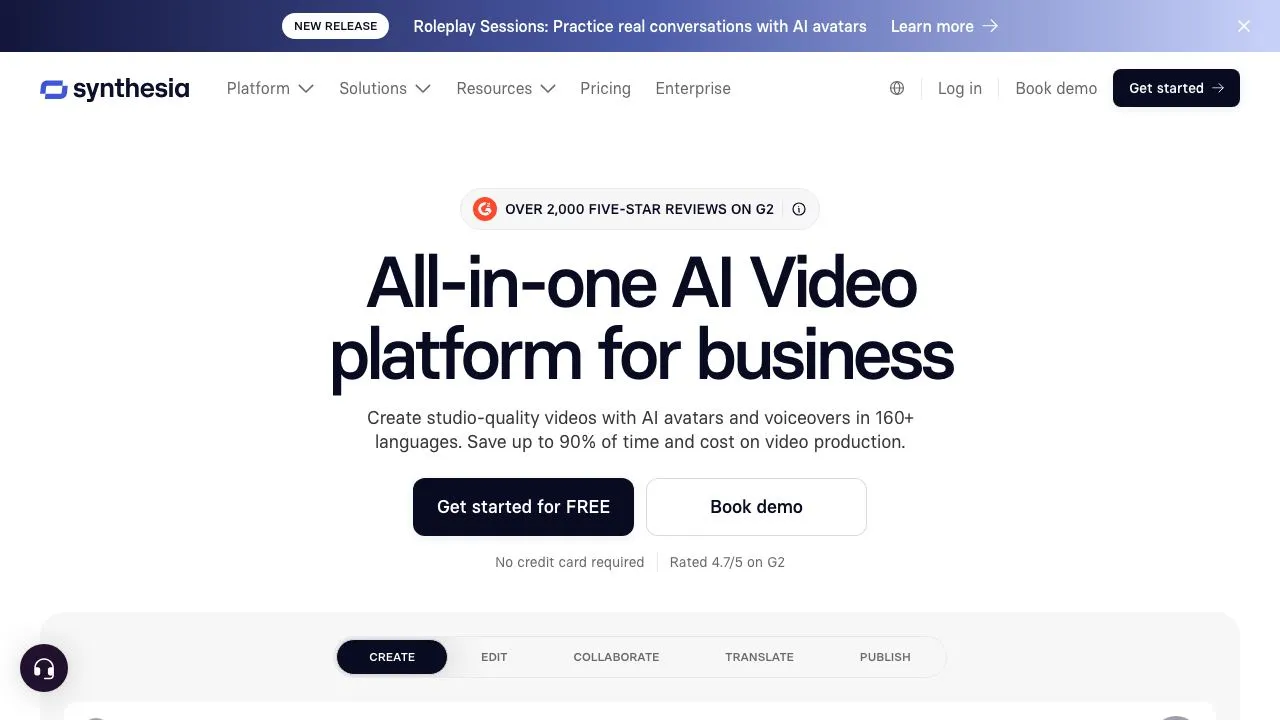
Synthesia is an AI video generation platform that converts text scripts into videos presented by lifelike AI avatars in 140+ languages, with no camera or editing skills required. It primarily serves enterprise L&D, internal comms, and marketing teams producing training, onboarding, and explainer content, and is used by a majority of the Fortune 100. Founded by AI researchers in London, it is the category's largest player, valued at $4B after a $200M Series E in early 2026.
What can Synthesia do?
230+ AI avatars
Large library of stock AI presenters, plus personal/custom avatars cloned from real people on Creator and Enterprise plans.
140+ languages and AI dubbing
Generate or dub the same video into 140+ languages and 160+ voices for localization at scale.
Text-to-video editor
Type or paste a script and get a finished presenter video with templates, scenes, and screen-recording support — no filming or editing skills needed.
AI Video Assistant
Turns documents, PDFs, and links into draft videos automatically on paid plans.
One-click updates
Edit the script and regenerate to update a video, avoiding costly reshoots for training content that changes often.
Interactive videos and branded pages
Creator and Enterprise plans add clickable/interactive elements and branded video share pages.
API access
Programmatic video generation available from the Creator plan up.
Enterprise security and SCORM
SAML/SSO, SOC 2-grade controls, and LMS-friendly exports aimed at corporate L&D teams.
Use cases
- Enterprise L&D and HR teams producing training/onboarding videos that need frequent updates and multi-language versions
- Internal comms and enablement teams replacing slide decks with presenter-led video at scale
- SaaS product/marketing teams making explainer and how-to videos without filming
- Companies needing SCORM/LMS-ready video with SSO and enterprise security
Look elsewhere if
- Performance-marketing teams wanting casual, handheld UGC-style ad creative — tools like Arcads or Captions Mirage are built for that native-ad look
- Anyone in regulated or sensitive verticals who can't tolerate opaque content-moderation blocks and 12-24h manual reviews
- High-volume creators on a budget — per-minute cost is steep versus credit-cheap competitors like HeyGen
Synthesia pros and cons
Pros
- Best-in-class avatar realism and voice quality across 140+ languages; G2 users repeatedly cite production time dropping from days to hours
- Genuinely easy for non-video people — type a script, pick an avatar, done (Capterra ease-of-use rated 4.7)
- Updating a video is a script edit and re-render, which reviewers say is ideal for frequently changing training content
- Free plan and low-cost Starter tier let you validate output quality before committing
- Mature, well-funded company ($4B valuation, Fortune 100 customer base) — low platform risk
Cons
- Aggressive content moderation: users report ordinary business videos blocked or delayed 12-24 hours for manual review, including one who paid $11,000 for a custom avatar of themselves (Trustpilot, Product Hunt)
- Unused monthly credits expire and small leftover balances can't produce a complete video (Trustpilot)
- Expensive per minute of output — ~$29/mo buys only ~10 min of video, and one reviewer noted a full annual sub yields only ~6 hours of generation (Trustpilot)
- Voices can still sound robotic on long narrations, with limited accent coverage (e.g., AU/NZ) and limited emotional range (Capterra)
- Product Hunt reviewers report failed renders stalling at 99% and account bans/policy restrictions that weren't clear upfront, with weak refund handling
Our Synthesia review
Our editorial score — not an average of the third-party star ratings in the sidebar. Built from Synthesia’s published pricing, contract and help center, with third-party reviews read for complaint patterns rather than their averages, and not from a paid hands-on test. Every price and quoted term was checked on 2026-09-03.
TL;DR: Synthesia holds a 4.7 on G2 and a 3.9 on Trustpilot for the same product. The gap is not noise. Trustpilot's distribution is 72% five-star and 13% one-star with almost nothing in between (verified 2026-09-03), and that 13% clusters into two things the help center confirms: fees are "non-cancelable" and "non-refundable," and credits are "reset at the start of the billing period" with "no accumulation of unused credit." Reviewers overwhelmingly rate the output well. The commercial terms are unforgiving for anyone who buys the wrong way.
Synthesia turns a typed script into a video presented by an AI avatar, in 140+ languages, with no camera and no editor. It is the category's largest company, valued at $4B after a Series E in early 2026, and it is built for corporate training, onboarding, and internal comms.
Almost every Synthesia review ranking on Google is written by a company selling a competing AI video tool, or by an affiliate. Synthesia pays 25% commission on all Starter and Creator plan payments (opens in a new tab) with a 60-day cookie — capped, per the affiliate terms (opens in a new tab), at "a duration of 12 months starting from the moment of first purchase." That explains the tone of those pages. We sell nothing and take no commission here.
What follows is what those pages skip: the contract, the credit arithmetic, and a list of buyers who should walk away.
How We Verified This
We have not paid for a Synthesia subscription, and nothing here is presented as hands-on testing. We read the documents you agree to when you click subscribe, then checked them against public review data. Four layers of evidence, all dated 2026-09-03:
- Primary contract. Synthesia's Customer Terms of Service (opens in a new tab) and Acceptable Use Policy (opens in a new tab), quoted verbatim.
- Official pricing and help center. The live pricing page (opens in a new tab) plus nine
help.synthesia.ioarticles covering credits, edit consumption, refunds, downgrades, the moderation guide, moderation FAQs, manual review, changing approvals, and appeals. - Public review corpora. Trustpilot (opens in a new tab) (1,820 reviews), Capterra (opens in a new tab) (314 reviews), and G2 (opens in a new tab) (~2,375 reviews), read for distribution shape rather than headline average.
- Practitioner forums. Cited by link, flagged as single unverified reports, never treated as proof.
G2's review page returned HTTP 403 to our fetch on 2026-09-03, so its 4.7/5 and review count are reported as G2 publishes them rather than as figures we independently retrieved. Where a fact is not published, we say so instead of guessing. There are four such places on this page and each one is labeled.
Why Does G2 Say 4.7 and Trustpilot Say 3.9?
Because the two panels bought different products. Trustpilot's 1,820 reviews split 72% five-star, 11% four-star, 2% three-star, 2% two-star, and 13% one-star (verified 2026-09-03). Only 4% sit in the middle. A straight average of that distribution is about 4.3; the published 3.9 is Trustpilot's weighted TrustScore, which discounts older reviews, so the headline number is harsher than the raw split. Either way this is not a mediocre product, it is a good product with a small, badly burned minority.
A score built from an 83/13 split carries a different risk profile than one built from a mass of lukewarm threes. Most buyers are delighted. Roughly one in eight hits something that makes them furious.
That eighth is legible. The one-star cluster resolves into billing mechanics and content rejections, not output quality. Nobody complains that the avatars look bad. They complain that credits vanished, that a renewal charged, or that a video was blocked with no usable explanation.
G2's panel skews enterprise L&D, where procurement signed a custom contract, the minute pool is effectively unlimited, and no individual ever sees a credit balance. Capterra sits between the two at 4.6 across 314 reviews, and its sub-scores rank the friction: value for money lowest at 4.3, customer service 4.4, features 4.5, ease of use 4.7.
So the reconciliation is this: if you buy Synthesia the way G2's reviewers buy it, you will probably rate it 5. If you buy it the way Trustpilot's reviewers buy it, on a card, monthly, in bursts, your odds of joining the 13% are real.
What Does Synthesia's Fine Print Actually Say?
Every row below comes from a Synthesia-owned document, verified 2026-09-03. Wording inside quotation marks is verbatim; three rows — forgotten cancellations, downgrades, and account ownership of Output — summarize rather than quote. Nothing here is disputed or hard to find. It is simply absent from every review currently ranking for this term.
| What you are agreeing to | Official wording | Source |
|---|---|---|
| Fees are non-refundable, even unused | "All purchases are non-cancelable and, except where the Contract expressly states otherwise, non-refundable." | Help center: refund and billing policy (opens in a new tab) |
| The contract says the same thing | "Payment obligations are non-cancelable and, except as expressly stated in the Contract, fees paid are non-refundable." | Customer Terms of Service (opens in a new tab) |
| Forgetting to cancel is not grounds for a refund | Forgotten cancellations do not qualify; you must cancel before the renewal date in account settings. | Help center: refund and billing policy (opens in a new tab) |
| Credits never roll over | "Credits for usage are reset at the start of the billing period and there is no accumulation of unused credit." | Help center: credits on self-serve plans (opens in a new tab) |
| Upgrading burns your existing balance | "Your unused credits from your previous plan do not carry over when you upgrade." | Help center: credits on self-serve plans (opens in a new tab) |
| Running out means waiting or upgrading | "If you use all your available credits, you'll need to upgrade to a higher-tier plan or wait for your credits to renew at the start of your next billing cycle." | Help center: credits on self-serve plans (opens in a new tab) |
| The unit of account is seconds, not videos | "Every second of a video uses 2 credits." AI Dubbing runs 120–240 credits/minute; API generation 75; Bulk Personalization 90. | Help center: credits on self-serve plans (opens in a new tab) |
| Auto-renewal needs 30 days' notice to stop | "Either party can give the other notice of non-renewal at least thirty (30) days before the end of a subscription term." | Customer Terms of Service (opens in a new tab) |
| Downgrades never refund the difference | Downgrades take effect at the start of the next billing period, with no proration. | Help center: how do I downgrade (opens in a new tab) |
| Studio Avatars cost $1,000/year and are annual-only | "The creation of a Studio Express-1 avatar is a paid add-on ($1000/year) for annual plan users only." They "can take up to 10 days to process." | Pricing page (opens in a new tab) |
| A produced Studio Avatar is never refundable | "Refunds for Studio Avatars aren't possible once the avatar has been produced and deployed to your account." | Help center: refund and billing policy (opens in a new tab) |
| Every single video is screened | "We moderate 100% of our content." Elsewhere: "100% of the content produced using Synthesia is moderated." | Guide to content moderation (opens in a new tab) |
| Repeatedly resubmitting rejected content risks your account | "Multiple submissions of rejected content may result in your account being suspended." The documented remedy is to duplicate the video, edit it against the rejection notice, and resubmit once. | Guide to content moderation (opens in a new tab), what to do if your video is rejected (opens in a new tab) |
| Free-plan users cannot appeal a rejection | "Appeals are available only to customers on paid plans. If you are using Synthesia on a Basics Plan, you will not have access to the appeals process." | Content moderation appeals (opens in a new tab) |
| Suspension is at Synthesia's discretion | "If we believe a violation... is deliberate, repeated or presents an undue burden or credible risk of harm... we may suspend or terminate your access." | Acceptable Use Policy (opens in a new tab) |
| You own your videos, but not the avatars inside them | "Customer will own all Customer Data, but excluding the components of the Services and Synthesia Content." | Customer Terms of Service (opens in a new tab) |
| Your license to stock avatars survives cancellation | A "non-sublicensable, non-transferable, non-exclusive, limited license" to Synthesia Content in your videos, continuing after the subscription ends. | Customer Terms of Service (opens in a new tab) |
| Your cloned face is unsupported after the term and deleted if you close the account | "Following the Term, Synthesia shall have no obligation to maintain, support or provide any Customer Data or Custom Avatars... and upon Customer's deletion of its account, Synthesia shall, unless legally prohibited, delete all Customer Data and Custom Avatars in its systems." | Customer Terms of Service (opens in a new tab) |
Two rows point in opposite directions.
The ownership and licensing clauses are genuinely good. You own the output, and your license to the stock avatar inside a finished video does not expire when you stop paying. Videos shipped in 2026 do not become unlicensed in 2028. That beats the twelve-month license renewals common on human UGC marketplaces.
The deletion clause is the one nobody covers, and it is narrower than it first reads. Simply not renewing removes Synthesia's obligation to "maintain, support or provide" your Custom Avatars; the commitment to actually delete them is triggered by deleting the account, not by churning. The practical result is the same for a buyer: spend $1,000 on a Studio Avatar of a named executive, stop paying, and nothing in the contract obliges Synthesia to keep it available to you. Good for privacy, expensive for you, and a reason to budget avatars as recurring cost rather than a one-time build.
What Do Synthesia Complaints Cluster Into?
Five recurring patterns, drawn from the public review corpora rather than from us. These are sentiment clusters, not our findings, and each one is a summary of what multiple reviewers describe rather than a verified account of any single incident.
1. Moderation rejections with no actionable reason. The most prominent theme in Trustpilot's one-star band. One reviewer describes clinically approved NHS material being repeatedly flagged (single unverified report, Trustpilot (opens in a new tab)). Capterra carries a matching complaint: "I had videos approved, only to have nearly identical versions later flagged without explanation" (Capterra (opens in a new tab), 314 reviews). Synthesia's help center concedes the mechanism rather than denying it: "Prior approval of similar or identical content does not guarantee future approval," because "our internal review standards and interpretations continue to evolve" (why content approval may change (opens in a new tab)).
2. Credit expiry surprise. Reviewers describe paying for a month, producing nothing that month, and losing the allowance. This is not a bug. It is the documented policy quoted above, and the complaint is really about disclosure timing rather than behavior.
3. Output volume versus price. The recurring shape is a buyer who expected a video subscription and received a minutes subscription. Ten minutes a month on Starter monthly is fewer than seven 90-second videos, and that ceiling is invisible until you hit it.
4. Expensive custom avatars that disappoint. One Trustpilot reviewer describes $11,000 spent, largely on a custom avatar, undermined by mispronunciation support could not resolve (single unverified report).
5. Support latency on time-sensitive work. Capterra scores customer service 4.4 against 4.7 for ease of use. Moderation appeals are answered within "48 hours" per the appeals article (opens in a new tab), and the moderation guide tells you to contact support only once a video has been in manual review "longer than 24 hours." Fine for a training rollout, useless for a Friday deadline.
Notice what is absent from all five. No cluster about avatar realism, language coverage, or the editor. Whatever else reviewers dislike, it is not the output. The friction is commercial and procedural.
What Does a Synthesia Video Really Cost Per Minute?
Between $1.80 and $10.13 per finished minute depending entirely on how you buy, and the cheapest tier is not the one you would guess. Every base figure below is QUOTED from the pricing page (opens in a new tab) on 2026-09-03. Every derived figure is our arithmetic, shown so you can check it.
| Buying shape | Annual outlay | Included minutes | Cost per minute | Status |
|---|---|---|---|---|
| Starter, billed annually | $216 ($18 × 12) | 120/yr | $1.80 | QUOTED base, computed |
| Starter, billed monthly | $348 ($29 × 12) | 10/mo, 120/yr | $2.90 | QUOTED base, computed |
| Creator, billed annually | $768 ($64 × 12) | 360/yr | $2.13 | QUOTED base, computed |
| Creator, billed monthly | $1,068 ($89 × 12) | 30/mo, 360/yr | $2.97 | QUOTED base, computed |
| Starter annual + 1 Studio Avatar | $1,216 | 120/yr | $10.13 | QUOTED base, computed |
| Creator annual + 1 Studio Avatar | $1,768 | 360/yr | $4.91 | QUOTED base, computed |
Three things fall out of that table that no ranking page mentions.
Creator costs more per minute than Starter. $2.13 versus $1.80, an 18% premium. You are not buying volume efficiency when you upgrade, you are buying API access, personal avatars, interactive video, and branded pages. If you only need minutes, staying on Starter and living with the 120-minute cap is the cheaper unit.
Monthly billing costs 61% more and buys worse credits. Starter monthly is $348 against $216, and the allowance arrives as twelve separate 1,200-credit buckets that expire individually rather than one 14,500-credit annual pool. A team that produces in quarterly bursts cannot use monthly buckets. Producing 30 minutes in March and nothing in April wastes April and blocks March.
Localization is where the math turns favorable. At 2 credits per second, a minute of video costs 120 credits, and AI Dubbing costs 120–240 credits per minute per language. Take 40 source minutes on Creator annual, dubbed into four languages: roughly 4,800 credits of base render plus about 28,800 credits of dubbing at the midpoint, against a 44,000-credit pool. That delivers 200 language-minutes for $768, or $3.84 per delivered language-minute (ESTIMATED; assumes 180 credits/min dubbing and no failed renders). Hiring four voice actors and an editor does not come close.
One correction to the received wisdom. Competing reviews claim a punitive re-render tax, that every revision re-bills the whole video. Synthesia's own documentation says otherwise: only new or modified words are charged, at 2 credits per second of changed material, while "removing existing words, reordering words, changing punctuation, adjusting avatar framing, modifying pronunciation" cost nothing (help center (opens in a new tab)). Revision overhead is real but incremental. A script edited twice, touching 30% then 15% of the copy, adds roughly 45% to that video's credit cost, not 200%.
For context, brand-side buyers discussing human UGC marketplaces on r/ecommerce (opens in a new tab) anchor at $50–$110 per video. A 90-second Synthesia clip on Starter annual costs about $2.70 in credits. These are not competing products, and the price gap is exactly why. See our UGC platform pricing breakdown for the human side.
What Does Synthesia Not Commit To?
Four things, and each one matters more than a missing feature. We looked for them across the pricing page, the Terms of Service, and nine help center articles on 2026-09-03. Two are genuinely absent. Two are published in a form too thin to plan around.
Whether a rejected video consumes credits. Genuinely absent. Not in the Content Moderation FAQs (opens in a new tab), the manual review article (opens in a new tab), the rejection article (opens in a new tab), or the credits article (opens in a new tab). On a metered plan where every second costs 2 credits, this is a first-order question and it is unanswered.
A commitment on manual review time. Published, but thin. The manual review article (opens in a new tab) says only that flagged videos "may take longer because they need to be assessed by the content moderation team." The moderation guide (opens in a new tab) does give one number: "If your video has been under manual review for longer than 24 hours please contact our Support Team." That is an escalation threshold, not a service commitment, and it is the only figure Synthesia publishes — the shorter half of the 12-to-24-hour range repeated elsewhere traces to user reports. Plan against 24 hours.
An exhaustive, checkable list of restricted categories. Published, but non-binding. The Content Moderation FAQs do name topics: "Restricted topics typically include politics, religion, health claims, legal advice, financial advice, adult content, and anything involving hate, misinformation, or real-world violence." So pharma, financial services, and legal are on notice, which is more than the moderation hub's four abstract policy areas (Harmful Behaviour, Disagreeable Content, Safety, Platform Integrity) suggest. What you cannot get is certainty. The same article concedes "we don't offer exhaustive lists per industry" and "we don't currently offer a pre-approval system." The offered remedy is to email support before you generate. That works for a planned campaign. It does not work for a queue.
Whether self-serve users can top up credits mid-cycle. Genuinely absent. The help center offers exactly two remedies for exhaustion, upgrade or wait. No credit pack, no overage rate, no top-up SKU is documented for Starter or Creator.
Who Should Not Buy Synthesia?
Six buyers, stated plainly. This is the section every competing page omits.
Performance marketers who want UGC-style ad creative. Synthesia makes polished presenter video. It does not make the handheld, imperfect, selfie-framed creative that wins in paid social, and the Acceptable Use Policy (opens in a new tab) bars using stock avatars "in a manner that is meant to, or is reasonably likely to, make viewers think the real-life actor personally holds, endorses, or actually has your stated opinions, characteristics or conditions" — absent an Enterprise plan and the actor's written consent. That is the core mechanic of a UGC testimonial ad. Look at Arcads or the options in our best AI UGC video generators roundup instead.
Anyone in a regulated vertical without a fallback plan. 100% of content is moderated, health claims and legal and financial advice are named restricted topics, there is no pre-approval system and no per-industry list, manual review carries a 24-hour escalation threshold rather than an SLA, and repeated resubmission "may result in your account being suspended." If a blocked render can miss a compliance deadline, this is a single point of failure you do not control.
Buyers who cannot commit to twelve months. The annual discount is 38%, but the prepayment is non-refundable and cancellation only stops the next renewal. Buying annually to save money and churning in month four means paying $216 for four months of access.
Teams with lumpy, bursty production. Monthly billing fragments your allowance into twelve expiring buckets. Annual billing fixes this and is the only sane way to buy Synthesia if your output is uneven.
Anyone budgeting a Studio Avatar as a one-time cost. It is $1,000 per year, annual-plan-only, non-refundable once produced and deployed, and unsupported the moment the term ends — deleted outright if you close the account. On Starter that single line item pushes your cost per minute from $1.80 to $10.13.
Free-plan evaluators testing sensitive content. Basic cannot download videos and cannot appeal a moderation rejection. Evaluating whether your content clears moderation is precisely the thing the free tier cannot tell you.
Final verdict
7.4/10. On the public record Synthesia is the best-reviewed product in this category and the one most likely to punish a careless buyer. We have not tested it; the point is that its output quality is not in dispute anywhere in 4,500 public reviews across three platforms. Neither are the terms, once you read them.
The deductions are all commercial. Fees are "non-cancelable" and "non-refundable" even when unused. Credits are "reset at the start of the billing period" with no accumulation. Every video is screened, free users cannot appeal, and manual review carries a 24-hour escalation threshold rather than an SLA. Monthly billing costs 61% more than annual and fragments your allowance into buckets that expire.
Buy it if you produce training, onboarding, or explainer video that needs frequent script updates and multiple language versions, and you can commit annually. At $3.84 per delivered language-minute in a localization workflow, nothing else in the category is close.
Skip it if you need UGC-style ad creative, work in a regulated vertical, or cannot predict twelve months of demand.
Next: see the head-to-head in Synthesia vs HeyGen, or sixteen AI-avatar alternatives priced against it.
Synthesia FAQ: refunds, credit rollover and custom avatars
Can I get a refund from Synthesia? Almost never. The help center states "All purchases are non-cancelable and, except where the Contract expressly states otherwise, non-refundable," and this applies even if the subscription went unused. Forgetting to cancel before renewal does not qualify. The only documented exception is a confirmed technical issue that blocked account access, reviewed case by case.
Do Synthesia credits or minutes roll over? No. "Credits for usage are reset at the start of the billing period and there is no accumulation of unused credit" (verified 2026-09-03). Upgrading mid-cycle also wipes your existing balance rather than adding to it. Annual plans grant one yearly pool instead of twelve monthly buckets, which is the practical reason to buy annually.
How much is a Synthesia custom avatar? A Studio Avatar is a paid add-on at $1,000 per year, available to annual-plan subscribers only, taking up to 10 days to process. It is not refundable once produced and deployed. Personal avatars recorded from webcam or video are included in plan allowances: 3 on Starter, 5 on Creator, unlimited on Enterprise.
Does Synthesia really review every video? Yes. Its own documentation states "We moderate 100% of our content," combining automated screening with manual review of flagged material. Synthesia publishes no SLA for manual review, only a threshold: contact support if a video has been in review "longer than 24 hours." Appeals are answered within 48 hours but are "available only to customers on paid plans."
Is Synthesia good for UGC-style ads? No. It produces polished presenter video, and its Acceptable Use Policy bars using stock avatars in ways likely to make viewers think the actor endorses your product, which is what a testimonial ad does, unless you are on Enterprise with the actor's written consent. For that format, look at purpose-built AI UGC tools or hire real creators through a marketplace.
What happens to my custom avatar if I cancel? Assume you lose access to it. The Customer Terms of Service state that "following the Term, Synthesia shall have no obligation to maintain, support or provide any Customer Data or Custom Avatars," and that "upon Customer's deletion of its account" it will, "unless legally prohibited, delete all Customer Data and Custom Avatars in its systems." Outright deletion is triggered by closing the account rather than by simply not renewing, but nothing obliges Synthesia to keep the avatar available to you either way. Export finished videos before your term ends.
Sources consulted
as of 2026-09-03- synthesia.io (opens in a new tab)
- trustpilot.com (opens in a new tab)
- g2.com (opens in a new tab)
- capterra.com (opens in a new tab)
- capterra.com (opens in a new tab)
- producthunt.com (opens in a new tab)
- producthunt.com (opens in a new tab)
- synthesia.io (opens in a new tab)
- ucl.ac.uk (opens in a new tab)
- tech.eu (opens in a new tab)
- synthesia.io (opens in a new tab)
- synthesia.io (opens in a new tab)
- getreditus.com (opens in a new tab)
- synthesia.io (opens in a new tab)
Quick facts about Synthesia
- Pricing
- Basic (Free)$0/moStarter$18/mo annual ($29 monthly)/moCreator$64/mo annual ($89 monthly)/moEnterpriseCustom/yr
Credit-metered minutes: unused monthly credits expire at the end of the billing cycle (a repeated Trustpilot complaint), and leftover credits too small for a full video are effectively unusable. Free plan does not allow video downloads. Annual billing saves ~38% vs monthly. Custom/personal avatars beyond plan allowances cost extra (one enterprise reviewer cited an $11,000 custom avatar). All generated videos pass content moderation, which can add manual review delays of 12-24 hours.
- Ratings
- 4.7 out of 5(2,375 reviews)on G2— read the G2 reviews (opens in a new tab)4.6 out of 5(314 reviews)on Capterra— read the Capterra reviews (opens in a new tab)3.9 out of 5(1,820 reviews)on Trustpilot— read the Trustpilot reviews (opens in a new tab)3.9 out of 5(24 reviews)on ProductHunt— read the ProductHunt reviews (opens in a new tab)
- Turnaround
- Minutes to render most videos; content moderation can add 12-24 hours of manual review, and custom avatar creation takes days
- Min. spend
- $0 (free plan, no downloads); $216/yr for the cheapest downloadable-video plan (Starter annual)
- Usage rights
- Commercial use of generated videos is included on paid plans, subject to Synthesia's content moderation and ethics policies (every video is screened; some business content gets blocked or delayed)
Frequently asked questions
Synthesia has a free Basic plan (about 10 minutes of video per month, no downloads), a Starter plan at $18/mo billed annually ($29 month-to-month) with roughly 120 minutes per year, a Creator plan at $64/mo annually with about 360 minutes per year plus API access, and custom-priced Enterprise plans with unlimited minutes.
Not really — Synthesia is optimized for polished, presenter-style corporate video (training, explainers, comms), not the casual selfie-style creative that performs in paid social. For UGC-style AI ad creative, tools like Arcads, Captions/Mirage, or TopView are a better fit, or hire real creators via a marketplace.
Yes. The Creator plan includes 5 personal avatars (webcam-based), and Enterprise plans offer unlimited studio-quality custom avatars. Custom avatar creation takes days, and all videos made with any avatar still pass Synthesia's content moderation.
Monthly credits expire at the end of each billing cycle, a frequent user complaint on Trustpilot. Annual plans grant a yearly credit pool, but leftover credits too small to render a complete video are effectively unusable.
Synthesia supports video generation and AI dubbing in over 140 languages with 160+ voices, which is one of its main draws for companies localizing training content globally.
Synthesia is stronger for enterprise training and comms (SSO, SCORM, moderation, large avatar library), while HeyGen is generally cheaper per minute and more popular with marketers and creators for ads and social content. Budget-conscious high-volume users often prefer HeyGen; compliance-focused enterprises lean Synthesia.
Alternatives to Synthesia
Looking for a Synthesia alternative? Compare these UGC platforms with similar use cases and verified pricing.
| Platform | Starting price | Model | Rating | Turnaround | |
|---|---|---|---|---|---|
| $18 /mo | Subscription | 4.7 out of 5 / 5 | Minutes to render most videos; content moderation can add 12-24 hours of manual review, and custom avatar creation takes days | Visit | |
| $24 /mo | Subscription | 3.7 out of 5 / 5 | Minutes for standard avatar videos (self-serve generation); custom avatar training takes longer | Visit | |
| $110 /mo | Subscription | 2.7 out of 5 / 5 | Minutes per generated video (AI generation, no creator shipping/filming) | Visit | |
| $24.99 /mo | Credit-based | 4.4 out of 5 / 5 | Minutes per video (self-serve AI generation, not a creator marketplace) | Visit | |
| $16 /mo | Credit-based | 3.5 out of 5 / 5 | Minutes for credit-based renders; 'unlimited' queue renders reported at 6-68 hours | Visit |