
Creator marketplace for UGC and creator ads with 100k+ creators across 35+ countries
Researched by Gan Liu · Founder & lead researcher
(Brand plan, billed annually)
Opens insense.pro in a new tab
Buy it only if you can prepay a full quarter and will actually publish 13 or more creator videos a month; below that the subscription eats the savings.
Best for dTC/Shopify brands running always-on UGC pipelines for Meta and TikTok ads
Skip it if brands needing a handful of one-off videos — per-video marketplaces like Billo are cheaper than a $400–650/mo minimum
What is Insense?
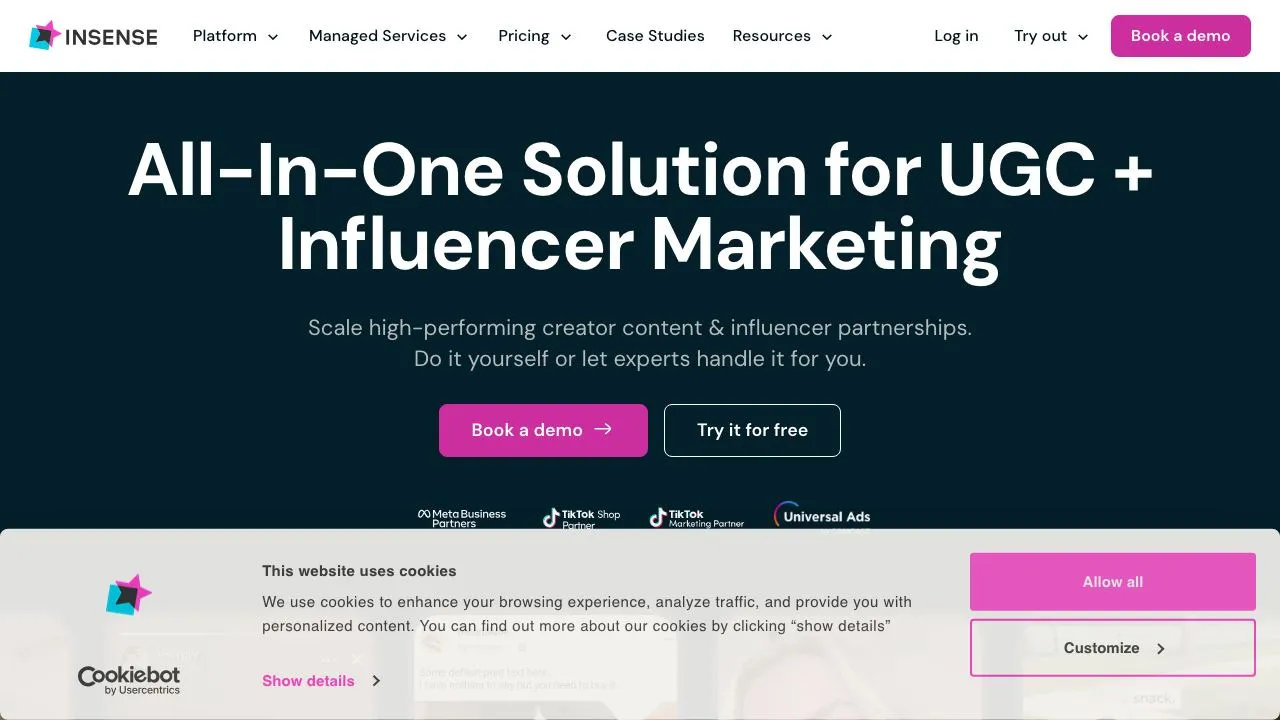
Insense is a subscription-based creator marketplace where DTC brands, mobile apps, and agencies source UGC and run influencer campaigns, with automated briefs, contracts, payments, and usage rights. Its differentiator is deep paid-social workflow integration — Meta Partnership Ads and TikTok Spark Ads connections are built into every plan — plus an optional managed service.
What can Insense do?
Creator marketplace
Post a campaign brief and receive applications from a network of 100k+ vetted creators across 35+ countries, typically within 48 hours.
Meta Partnership Ads & TikTok Spark Ads
Built-in ad-code and partnership-ad connections let brands run creator content as paid social directly from the platform.
Automated contracts and payments
Contracting, creator payouts, and digital copyright transfer are handled inside the platform via the Payments & Copyrights workflow.
Creative brief templates
Structured brief builder with pre-launch feedback from the Insense team to improve creator match quality.
Influencer outreach automation
Search and outreach tooling covering a claimed 7M+ influencer database beyond the core marketplace.
Content library and rights management
Approved assets with perpetual usage rights are stored centrally for reuse across ad accounts.
Managed service option
A done-for-you tier where Insense's team runs sourcing and campaign management on the brand's behalf.
Shopify integration
Product seeding and order workflows connect to Shopify stores for gifting-based campaigns.
Use cases
- DTC/Shopify brands running always-on UGC pipelines for Meta and TikTok ads
- Agencies managing multiple brands (5 brands, 7% fee on Agency plan)
- Mobile app marketers scaling creator ads with Spark Ads / Partnership Ads
- Teams that want sourcing, contracts, payments, and rights in one subscription
Look elsewhere if
- Brands needing a handful of one-off videos — per-video marketplaces like Billo are cheaper than a $400–650/mo minimum
- Teams needing deep influencer analytics and reporting — platforms like GRIN or Upfluence go deeper
- Budget-sensitive buyers wary of quarterly auto-renewal and no-refund terms
Insense pros and cons
Pros
- Clean, intuitive interface praised by both brands and creators on Trustpilot
- Fast creator matching — applications typically arrive within 48 hours
- Perpetual usage rights included automatically on content approval, no separate rights fees
- Strong paid-social workflow: Meta Partnership Ads and TikTok Spark Ads connections on every plan
- Consolidates briefs, chat, approvals, contracts, and payments in one place
Cons
- Auto-renewal complaints: users report being charged $1,500 for a quarter after attempting to cancel, with a strict no-refund stance (Trustpilot)
- Customer support described as unresponsive or unhelpful when problems arise (Trustpilot)
- Marketplace fee of 7–20% on top of every creator payment adds meaningful hidden cost
- Reporting/analytics described as surface-level versus deeper influencer-analytics platforms (G2)
- Inconsistent creator responsiveness and content quality in niche categories; some brands call output mediocre (G2/Capterra reviews)
Our Insense review
Our editorial score — not an average of the third-party star ratings in the sidebar. Built from Insense’s published pricing, contract and help center, with third-party reviews read for complaint patterns rather than their averages, and not from a paid hands-on test. Every price and quoted term was checked on 2026-09-03.
TL;DR: Insense is a competent creator-ads platform wrapped in unusually strict commercial terms. There is no month-to-month billing. The only checkout options are quarterly and annual (insense.pro/pricing (opens in a new tab), verified 2026-09-03), the $650 trial auto-converts to a $1,500 quarter, and non-enterprise cancellation requires 48 hours' notice. Trustpilot shows 3.7/5 across 187 reviews with 24% at one star.
Insense is a subscription marketplace where brands post a brief, receive creator applications, run revisions, pay creators, and push the approved videos into Meta Partnership Ads or TikTok Spark Ads without leaving the platform. It has been operating since 2016 and claims 100,000+ creators across 35+ countries.
Many of the reviews ranking for this term are published by companies that sell competing UGC services. This review takes a different route: it reads the subscription terms, the creator terms, and the help center, quotes them, and then does the arithmetic those documents imply.
The short version is that the software is fine and the contract is the risk.
How We Verified This
We have not purchased Insense, run a paid campaign, or received creator files from it. No one on this site sells UGC. Every number below traces to a public document with a fetch date, and where a document is silent we say so rather than guess.
Four layers of evidence sit behind this page:
- Primary documents. The pricing page, the Terms of Service for brands, the Terms of Service for creators, and the help center, all fetched 2026-09-03 and quoted verbatim.
- Public review corpora. Trustpilot (187 reviews), read directly for distribution and recurring themes. G2's review page could not be read at all (see the limitation below), so its score and count appear here as metadata and nothing more.
- Arithmetic. Total-cost scenarios built only from published rates. Every input is tagged QUOTED or ESTIMATED.
- Named gaps. Things Insense does not publish are listed as gaps, not filled in from third-party blogs.
One limitation to state plainly: G2 returned HTTP 403 to our fetch on 2026-09-03, so the G2 figures below come from G2's own listing metadata surfaced in search rather than from the page itself. That metadata carries an average and a review count. It does not carry a star distribution or any review text, so we quote neither.
How Much Does Insense Cost in 2026?
Insense starts at $650 for a one-month trial, then $400-$800 per month depending on plan and billing term (insense.pro/pricing (opens in a new tab), verified 2026-09-03). Creator payments are separate. A marketplace fee of 7-20% is added on top of every creator payment.
| Plan | Quarterly | Annual | Seats / Brands | Marketplace fee |
|---|---|---|---|---|
| Trial | $650 one month | n/a | 1 / 1 | 20% |
| Brand | $500/mo ($1,500 per quarter) | $400/mo ($4,800 upfront) | 2 / 1 | 10% |
| Agency | $800/mo ($2,400 per quarter) | $640/mo ($7,680 upfront) | 4 / 5 | 7% |
Add-ons carry their own line items, all three published on the same pricing page: extra user seat $30/month, extra brand $100/month, five additional Meta Partnership Ads connections $125/month.
The pricing page is explicit that the subscription buys software, not content: "Creator payments are not covered and must be budgeted separately." It anchors creator rates at "UGC campaigns start at $100 per video" and sponsored posts "beginning at $125 for nano-influencers."
Insense does not publish managed-service pricing. Third-party blogs quote figures from roughly $1,800 to $2,900 per month, none of which traces back to an Insense document, so we treat all of them as unverified.
What Does the Fine Print Actually Say?
The contract is stricter than the marketing. There is no monthly plan, the term auto-renews at the same length, the cancellation window is 48 hours, and the usage rights you receive are digital and CTV only. Every row below is quoted from a document we fetched on 2026-09-03.
| Term | What the document says | Source |
|---|---|---|
| Billing term | "an initial term of 3 months ('Quarterly') or 12 months ('Annual')" | ToS (opens in a new tab) |
| Monthly billing | No monthly option at checkout. Toggles read "Pay quarterly" and "Pay annually" | Pricing (opens in a new tab) |
| Auto-renewal | "The Subscription Term will automatically renew for the same term as the term of the Subscription at the same Subscription Fee" | ToS (opens in a new tab) |
| Cancellation notice | "upon 48 hours' notice" for non-enterprise; "upon 30 days' notice" for enterprise | ToS (opens in a new tab) |
| Trial conversion | "Any Subscription that is on a trial basis shall automatically upgrade to a Quarterly one and Sponsor shall be charged a corresponding fee upon expiration of the trial Subscription." | ToS (opens in a new tab) |
| Annual billing | "the Subscription Fees for the 12 months will be charged upfront in full to the credit card" | ToS (opens in a new tab) |
| Refunds | No general refund clause found. The only refund promise is applicant-count based: "If the applicants do not match the profile set in your brief, we will refund your subscription." | Pricing (opens in a new tab) |
| Usage rights granted | "non-exclusive, royalty-free, worldwide, perpetual, sub-licenseable, irrevocable right to use, modify, create derivative works of, reproduce, distribute... for the sole purpose of organic and paid use on digital marketing and/or connected TV (CTV) channels" | ToS (opens in a new tab) |
| Channels named | Social media, websites, digital newsletters, blogs, email marketing | Help center (opens in a new tab) |
| Rights not granted | Linear/broadcast TV, print, and out-of-home are not named anywhere. No extension mechanism or price is published. | Gap |
| Revisions | "up to 3 round of revisions included in the Creator Fees and any further rounds of revisions subject to additional fees" | Creator ToS (opens in a new tab) |
| Marketplace fee split | "5% covers the operational costs associated with payment facilitation"; "The remaining 5% helps cover those administrative costs." | Pricing (opens in a new tab) |
| Creator exclusivity | "Creator agrees that Campaign Content will only be amplified or licensed exclusively through Insense during and after the term of these Terms of Service." | Creator ToS (opens in a new tab) |
| AI credits | "AI-credits paid for such AI Campaign Content are nonrefundable." | ToS (opens in a new tab) |
| On termination | "Any termination of a Subscription will automatically lead to termination of any Campaigns active under Sponsor's Account" | ToS (opens in a new tab) |
| Disputes | "referred to and determined by a single arbitrator in a final and binding arbitration" | ToS (opens in a new tab) |
Three of these deserve emphasis.
The applicant guarantee is widely misread as a quality guarantee. It is not. It promises "at least 5 applicants matching your specified profile will apply to your campaign." It says nothing about delivery, content quality, or performance.
CTV is included and broadcast is not. If your media plan touches linear TV, print, or billboards, the license you receive by default does not cover it, and Insense publishes no path to extend it.
Perpetual rights are real, but they are non-exclusive and they attach at approval. Approval is the hinge in this contract: it is what transfers the license and what ends your three included revision rounds. Treat it as the irreversible step, because Insense publishes no procedure for undoing one.
Why Do G2 and Trustpilot Disagree So Sharply?
Insense scores 4.5/5 across 374 reviews on G2 (opens in a new tab) and 3.7/5 across 187 reviews on Trustpilot (opens in a new tab). We can only see inside one of those two numbers. G2 blocked our fetch, so we have its average and its count but not its star distribution. Trustpilot's distribution is public, and it is barbell-shaped: 56% five-star, 24% one-star, and 20% spread across the middle three bands (verified 2026-09-03).
The likeliest explanation for the 0.8-point gap is venue rather than product. A solicited B2B review corpus and a walk-in complaint venue collect different people. Nobody opens a G2 account to dispute a charge. They open Trustpilot. We offer that as the plausible reading, not as something we confirmed on G2's side.
What follows is a clustering of Trustpilot review text, not our conclusion about how Insense operates.
Pattern 1: the quarter nobody meant to buy. The most repeated one-star theme is a subscription that renewed or converted before the user expected. A March 2026 reviewer describes a subscription that "renewed for $1500 for 3 months" before they could stop it. An April 2026 reviewer writes that "they charge my credit card 2 times" and says they were scammed. This maps directly onto two quoted clauses: automatic trial conversion to a quarterly plan, and a 48-hour cancellation window.
Pattern 2: support silence. Trustpilot's own profile statistics show Insense replied to 4% of negative reviews, typically within one month. That is a measurable service signal, and it is more useful than any adjective. A March 2026 reviewer describes contacting customer service "so many times" with "no response ever."
Pattern 3: creator variance. The recurring caveat inside otherwise positive reviews is that creator quality varies and matching takes screening effort. This is normal marketplace behavior, but it shifts labor onto your team that a per-video production service would absorb.
Pattern 4: price shock at renewal. A May 2026 reviewer writes that "1500$ is very expensive for that kind of service." That figure is exactly one Brand quarter, which suggests the shock is about the billing unit rather than the monthly rate.
The through-line: almost every serious complaint is a billing complaint, and every billing complaint has a matching clause in the published terms. The terms are not hidden. They are simply not read.
What Does a Usable Video Actually Cost?
At Insense's own published floor of $100 per video on the Brand plan, the true blended cost is $110 per video in variable cost plus $500 a month in fixed subscription. At 5 videos a month that is $210 per video. At 20 it is $135. Volume is the entire argument.
Every input below is tagged QUOTED (published by Insense) or ESTIMATED (our assumption, stated).
Scenario A. First month, small DTC brand, 5 videos, Trial plan.
| Line item | Amount | Basis |
|---|---|---|
| Trial subscription | $650 | QUOTED |
| Creator fees (5 x $100 floor) | $500 | QUOTED floor |
| Marketplace fee at 20% | $100 | QUOTED rate |
| Product samples and shipping | $150 | ESTIMATED at $30/creator |
| Month 1 total | $1,400 | $280 per video |
If you do not cancel at least 48 hours before the trial ends, a $1,500 quarterly charge follows. Entry cost across the first four months is therefore $2,150 in subscription alone, before a single creator is paid.
Scenario B. Growth brand, Brand plan quarterly, 15 videos a month.
| Line item | Amount | Basis |
|---|---|---|
| Subscription | $500 | QUOTED |
| Creator fees (15 x $100 floor) | $1,500 | QUOTED floor |
| Marketplace fee at 10% | $150 | QUOTED rate |
| Product samples and shipping | $375 | ESTIMATED at $25/creator |
| Monthly total | $2,525 | $168 per video |
Scenario C. Agency, Agency plan quarterly, 3 brands, 30 videos a month.
| Line item | Amount | Basis |
|---|---|---|
| Subscription | $800 | QUOTED |
| Creator fees (30 x $100 floor) | $3,000 | QUOTED floor |
| Marketplace fee at 7% | $210 | QUOTED rate |
| Product samples and shipping | $750 | ESTIMATED at $25/creator |
| Monthly total | $4,760 | $159 per video |
Three costs sit outside these tables and should be planned for. Revision rounds beyond three are "subject to additional fees" per the creator terms. Insense publishes no mechanism for reversing an approval, so budget for anything you accept and then decide not to run being a sunk cost. And on annual billing the full $4,800 or $7,680 is charged upfront, which is a cash-flow event, not a discount.
The sample-and-shipping lines are our own estimates, not Insense figures: $30 per creator in Scenario A and $25 in B and C, on the assumption that a five-creator batch ships less efficiently than a fifteen- or thirty-creator one. Substitute your own number — it moves the per-video result by $5 to $30.
The crossover is easy to compute. Blended cost per video on the Brand plan is $110 plus $500 divided by monthly volume. It drops below $150 per video at roughly 13 videos a month.
That number matters because brand-side buyers anchor low. A r/ecommerce thread comparing SocialCat, Billo, and Trend (opens in a new tab) has brand-side posters anchoring at roughly $50 to $110 per video. On the Brand plan at Insense's own floor rate, the blended cost can never fall below $110 at any volume. Insense is not competing in that band and does not claim to.
For cross-platform math, see our UGC platform pricing breakdown.
What Is Insense Genuinely Good At?
The paid-social plumbing is the reason to pay for this. Meta Partnership Ads connections are included on every tier and TikTok Spark Ads codes are handled in-platform, which removes the usual scramble of chasing creators for ad codes after delivery.
Three other things hold up under document review. Rights transfer is automatic at approval with no separate licensing fee, which is genuinely cleaner than platforms that sell usage rights as an upsell. Contracting and payouts run inside the platform, so you are not managing invoices from twenty individuals. And the agency tier at 5 brands and a 7% fee is priced sensibly for shops running several accounts.
Insense also markets a 48-hour window for a brief to attract applicants. That is the vendor's number and we did not measure it — we have not run a campaign, and the review text we could read does not time it.
Who Should Not Buy Insense?
Skip Insense if any of the following is true. Each one traces to a clause quoted earlier on this page.
You cannot prepay three months. There is no ongoing monthly plan — the $650 trial is the only one-month purchase, and it converts. The smallest real commitment after it is $1,500. If that is a meaningful share of your monthly ad budget, the lock-in risk outweighs the tooling.
You need fewer than about 13 videos a month. Below that volume the $500 subscription is dead weight spread across too few assets. A per-video marketplace will be cheaper. See Billo vs Insense.
Your media plan includes TV, print, or out-of-home. The default license covers digital and CTV only. Broadcast, print, and OOH are not named in the terms, and no extension price is published.
Your approval cycle is slow or committee-driven. Revisions stop at three rounds before extra fees apply, and the 48-hour cancellation window punishes teams that make decisions on a weekly cadence.
You need per-asset ROAS attribution inside the tool. Reporting is a recurring complaint in review summaries of this platform, described as surface-level next to dedicated influencer-analytics tools. Insense publishes no attribution documentation we could check, so treat this one as reported rather than verified, and assume you will be exporting to your own dashboard.
You are a creator deciding whether to join. Read the exclusivity clause first: campaign content "will only be amplified or licensed exclusively through Insense during and after the term of these Terms of Service." Combined with a perpetual, irrevocable sublicense to the brand, that is a permanent commitment on work you produced.
What Are the Best Insense Alternatives?
The right alternative depends on whether your problem is volume, lock-in, or rights scope.
Billo. Per-video rather than subscription, which suits low volume. Note that Billo's public pricing URL redirected to a login screen when we checked on 2026-09-03, so its current rate card cannot be quoted from source. A brand-side poster on r/adops (opens in a new tab) reports being quoted $200 per video plus a $5,000 deposit to unlock performance benchmarks, AI briefs, and creator outreach. That is one anonymous account and we could not independently confirm it. Compare at Billo vs Insense.
JoinBrands. Task-based pricing with no subscription floor, better for irregular volume. See Insense vs JoinBrands.
soona (formerly Trend). Pay-per-video from $89 to $259 with unlimited worldwide perpetual rights included in the price — no credit packages and no annual commitment, which is the opposite of Insense's shape. soona's studio photography sits alongside the UGC product if you need stills and video from one relationship. See Trend vs Insense.
Collabstr. No platform subscription on the entry tier, with commission taken per booking instead. Reasonable for a handful of collaborations a quarter. See Collabstr.
For the full field, see the best UGC platforms.
Insense FAQ
Does Insense have a free trial? No. The entry option is a paid $650 one-month trial capped at 10 creators and 1 campaign. It auto-upgrades to a quarterly Brand plan unless canceled at least 48 hours before it ends.
Can I pay Insense monthly? No. As of 2026-09-03 the pricing page offers only "Pay quarterly" and "Pay annually," and the terms define subscriptions as 3-month or 12-month.
Who owns Insense content? Creators keep copyright. Brands receive a non-exclusive, perpetual, irrevocable, sublicensable license limited to digital marketing and CTV channels, granted at approval. Note that "perpetual rights" in Insense's marketing means this license, not ownership.
Does Insense refund? No general refund clause appears in the terms. The one published promise is that if fewer than five profile-matching applicants apply, Insense will refund the subscription.
Is Insense worth it? Above roughly 13 videos a month with an active Meta or TikTok creator-ads program, yes. Below that, the subscription floor makes per-video marketplaces cheaper.
Final verdict
Insense earns a middling score for a specific reason. The product is good and the commercial terms are aggressive, and those two facts do not cancel out.
What you get is a working pipeline from brief to Spark Ads with rights handled cleanly and no separate licensing invoice. What you accept is quarterly prepayment, automatic renewal at the same term, a 48-hour cancellation window, a 7-20% surcharge on every creator payment, and a license that stops at the edge of digital and CTV. A Trustpilot tail with 24% at one star, concentrated on billing, is the visible cost of those terms.
Buy it if you are running always-on creator ads at real volume and can treat $1,500 a quarter as fixed cost. Do not buy it to test whether UGC works for you. That is what the $650 trial looks like it is for, and the auto-conversion clause is what makes it something else.
Verification log. Pricing page, brand Terms of Service, creator Terms of Service, and help center article 4243 ("Who owns the content created on Insense and how can they use it?") fetched and quoted 2026-09-03. Trustpilot profile read 2026-09-03: 3.7/5, 187 reviews, distribution 56/8/8/4/24, replied to 4% of negative reviews. G2 returned HTTP 403 on 2026-09-03; the 4.5/374 figure comes from G2 listing metadata, not the page, and no G2 star distribution or review text is quoted anywhere above. The two Reddit threads cited are linked for attribution but blocked to automated fetch, so neither is independently confirmed. Billo's public pricing URL redirected to a login screen on 2026-09-03. Insense does not publish managed-service pricing, a usage-rights extension process, or a general refund policy. We are not an Insense customer and we do not sell UGC.
Sources consulted
as of 2026-09-03- insense.pro (opens in a new tab)
- insense.pro (opens in a new tab)
- trustpilot.com (opens in a new tab)
- g2.com (opens in a new tab)
- influee.co (opens in a new tab)
- influencer-hero.com (opens in a new tab)
- nc-media-group.com (opens in a new tab)
- crunchbase.com (opens in a new tab)
- influencermarketinghub.com (opens in a new tab)
Quick facts about Insense
- Pricing
- Trial$650Brand$500/mo quarterly or $400/mo annual/moAgency$800/mo quarterly or $640/mo annual/mo
Creator payments are NOT included in the subscription — budget them separately (UGC videos commonly start around $100 each per third-party reviews). A 7–20% marketplace fee is added on top of every creator payment depending on plan. The $650 trial auto-upgrades to the Brand plan after 30 days unless canceled 48 hours in advance; brands report auto-renewal charges (e.g. $1,500/quarter) with a strict no-refund stance. Managed service reportedly starts around $1,800/mo (third-party source).
- Ratings
- Turnaround
- Creator applications within 48 hours; content delivered in roughly 14 days (product shipping and revisions can extend this)
- Min. spend
- Realistically ~$650 first month (paid trial) plus creator costs; ongoing $400–500/mo subscription plus creator payments and 7–20% marketplace fee — third-party estimates put realistic all-in monthly spend at $2,000+
- Usage rights
- Perpetual usage rights granted automatically upon content approval and recorded in the platform's Payments & Copyrights workflow; no separate rights fee
Frequently asked questions
Self-service plans start at $400/mo on annual billing ($500/mo quarterly) for the Brand plan; the Agency plan is $640–800/mo. There is a one-month paid trial at $650. Creator payments are separate, with a 7–20% marketplace fee added on top.
No. The entry option is a $650 one-month paid trial limited to 10 creators and 1 campaign. It auto-converts to the Brand plan after 30 days unless you cancel at least 48 hours before renewal.
The brand does. Perpetual usage rights transfer automatically when you approve content, handled through Insense's Payments & Copyrights workflow, so there are no separate usage-rights fees.
Insense says creator applications arrive within 48 hours of posting a brief, and content is typically delivered within about 14 days, depending on product shipping and revision rounds.
Yes — this is its main differentiator. Meta Partnership Ads connections are included on every plan (1 on Trial, 10 on Brand, unlimited on Agency) and TikTok Spark Ads codes are handled in-platform.
The most common complaints on Trustpilot are auto-renewal billing (e.g., being charged $1,500 for a quarter after trying to cancel), slow or unhelpful support, and occasional unreliable brand/creator counterparties. G2 reviewers also flag surface-level reporting.
Alternatives to Insense
Looking for a Insense alternative? Compare these UGC platforms with similar use cases and verified pricing.
| Platform | Starting price | Model | Rating | Turnaround | |
|---|---|---|---|---|---|
| $400 /mo | Subscription | 4.5 out of 5 / 5 | Creator applications within 48 hours; content delivered in roughly 14 days (product shipping and revisions can extend this) | Visit | |
| $99 /video | Custom quote | 4.1 out of 5 / 5 | Typically 7-12 days after the creator receives the product (per Billo's help center); shipping time extra | Visit | |
| Free to browse | Marketplace fee | 4.5 out of 5 / 5 | — | Visit | |
| $89 /video | Per video | 4.0 out of 5 / 5 | ~7 days after the creator receives the product | Visit | |
| ~$478 /mo | Custom quote | 4.6 out of 5 / 5 | — | Visit |